
South Africa's most alarmingly named dish contains no monkey and no glands. What it does contain is a glossy, sweet-sharp sauce of ketchup, chutney, Worcestershire and garlic, spooned over a steak seared hard and fast. It is a steakhouse classic, a braai fixture, and one of the great pantry sauces of the world.
Ingredients
Instructions
Start the sauce. Heat the olive oil in a saucepan over medium-low heat. Add the onion and garlic and cook gently for 8 to 10 minutes, until soft and translucent. Don't let the garlic colour.
Add everything else. Stir in the tomatoes, ketchup, chutney, Worcestershire, vinegar, brown sugar, Tabasco and water. Season with salt and pepper.
Simmer. Cook uncovered at a lazy bubble for about 15 minutes, stirring now and then, until the tomatoes have collapsed and the sauce is thick and glossy. Taste it. It should be sweet, sour and savoury all at once, with the vinegar clearly present — if it tastes flat, add vinegar rather than sugar. Keep warm.
Bring the steaks to room temperature and pat them completely dry. Season generously on both sides with salt and pepper.
Sear. Heat the neutral oil in a heavy skillet over high heat until it just begins to smoke. Lay the steaks in without crowding the pan — work in two batches if you need to. For a 1-inch steak, cook about 3 minutes per side for medium-rare (130°F), or 2 minutes per side for rare (120°F). Don't move them around while they cook.
Rest. Transfer to a warm platter and leave for 5 minutes. This is not optional; cutting straight in loses the juice.
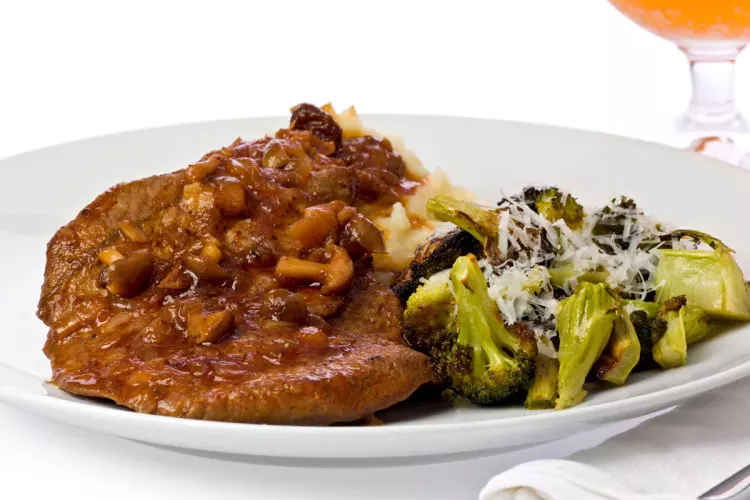
Serve. Spoon the warm sauce generously over the steaks, and put any extra on the table.
Notes
The chutney matters most. South Africans use Mrs Ball's, a peach-and-apricot chutney that's sweet, sour and mildly spicy all at once, and it's what gives the sauce its character. It's exported and easy to order online. If you can't get it, Major Grey's mango chutney is the closest widely available substitute — but taste as you go, since it runs sweeter.
Go carefully with the sugar. Between the ketchup and the chutney there's already a lot of sweetness in this sauce. Start with 1 tablespoon of brown sugar and add more only after tasting at the end. Many versions of this recipe tip over into cloying.
Deglaze the steak pan. After the steaks come out, tip a splash of the sauce into the hot skillet, scrape up the browned bits, and stir it back into the pot. Thirty seconds of work for a noticeably better sauce.
Make it ahead. The sauce keeps for a week in the fridge and improves after a day. Reheat gently and loosen with a spoonful of water if it has thickened.
Choose a steak with some fat. This is an assertive sauce and it will bully a lean cut. Ribeye or a well-marbled sirloin stands up to it best.
What to serve alongside. In South Africa this comes with chips or with pap, the soft maize porridge. Rice works. So does a plain green salad, which you'll want against all that sweetness.
Variations
On a burger. Arguably its most common use in South Africa today, and very good.
With brandy. The earliest versions of the dish were finished with flamed brandy at the table. Add 2 tbsp to the pan after searing, off the heat, and let it cook away before adding the sauce.
Hotter. Double the Tabasco, or add a chopped fresh chilli with the onion. The sweetness takes more heat than you'd think.
Smokier. A teaspoon of smoked paprika, or cook the steaks over charcoal instead — a braai is the sauce's natural home.
As a dipping sauce. Onion rings, in particular. This is standard practice.
Without steak. The sauce works on grilled chicken, pork chops, or roasted potatoes.
Source
First things first: no monkeys are involved, and South Africans find the reaction of visiting diners fairly entertaining. The country has form here — bunny chow, the hollowed-loaf curry, contains no rabbit either.
The name traces back to a genuine and thoroughly strange piece of medical history. In the 1920s, the Russian-born French surgeon Serge Voronoff became internationally famous for grafting slices of monkey testicle tissue onto men, claiming it would reverse ageing. His first transplant was in 1920, and the craze was enormous: Irving Berlin wrote a song about it, and Arthur Conan Doyle worked monkey gland extracts into a Sherlock Holmes story. "Monkey gland" was, for a few years, shorthand for rejuvenation.
How that name reached a South African steak is disputed, and there are two accounts.
The better-documented one runs through the Savoy Hotel in London, where Voronoff was a regular and reportedly favoured a steak in a tangy sauce, flambéed at the table with brandy by the Italian maître d'. The staff named the dish after him. An Italian waiter at the Savoy, Fiorino Luigi Bagatta, emigrated to South Africa in 1935 and introduced flamed steak with monkey gland sauce at the old Carlton Hotel in Johannesburg. Bagatta gave this account himself, in person, decades later.
The other story is the one South Africans tell more often, and it's better as a story than as history: that French chefs at the Carlton, exasperated by diners drowning their carefully made food in ketchup and chutney, mixed all the offending condiments together as a joke — and watched it become the most popular thing on the menu.
The two aren't entirely incompatible, and neither is fully proven. What is clear is that the sauce changed a great deal on its way to the present. The Savoy original was closer to a classic French pan sauce, built on mustard, Worcestershire, butter, shallots, parsley and brandy. The version South Africans make today is a pantry sauce, assembled from bottles most households already have, and by the 1970s it was a national staple. It's now a steakhouse default, a braai standard, and the thing that goes on the burger.