
Ceebu jën (thiéboudienne)
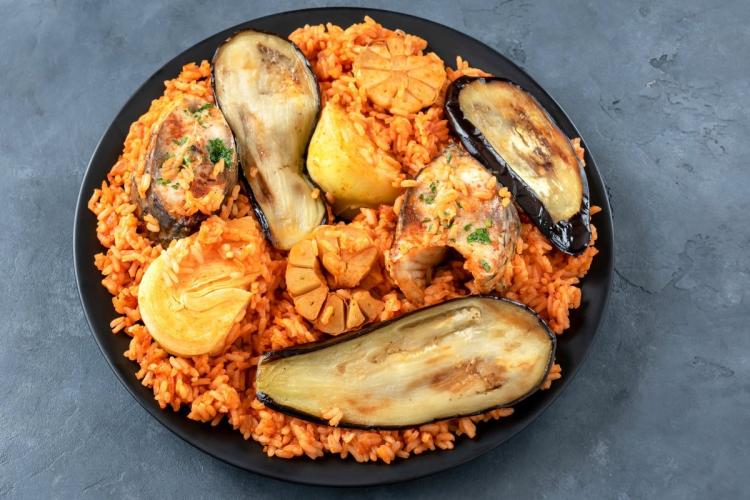
Fish simmered in a rich tomato broth with cassava, cabbage, carrot, and eggplant, then served over rice cooked in that same flavorful liquid. Known in Senegal as ceebu jën (or thieboudienne), this is the country's national dish and a centerpiece of family meals and celebrations across West Africa.
Ingredients
Instructions
In a bowl, mix the garlic, parsley, and dried chile, and season with salt and pepper. Coat the fish pieces and the dried cod well in this mixture and set aside.
Heat the oil in a large heavy pot over medium heat. Cook the onion until soft, then add the fish and dried cod and brown lightly on both sides. Stir in the tomato purée and simmer gently for 10 minutes.
Add the water and the prepared vegetables, season with salt and pepper, and simmer for about 1 hour, until the vegetables are tender. About 20 minutes after adding the water, lift out the fresh fish once it is cooked through and keep it warm, so it does not fall apart.
Lift the vegetables out of the pot as well, leaving the dried cod and the broth behind, and keep everything warm with a ladleful of broth.
Rinse the rice and add it to the broth in the pot, adding a little water if needed so the liquid just covers the rice. Cover and cook over low heat for about 15 to 20 minutes, until the rice is tender and has absorbed the broth.
Spoon the rice onto a warmed platter and arrange the vegetables and fish on top. Serve with lemon wedges.
Notes
If the dried cod is not already desalted, soak it in cold water for 12 to 24 hours, changing the water several times.
Grouper is the classic fish for this dish, but any firm white fish that holds together in a stew, like snapper or sea bass, works well.
Peel the yuca and remove the tough woody core before cutting it.
Traditional cooks use broken rice, which absorbs the broth and cooks quickly. Long-grain rice is a good substitute.
The tomato purée can be replaced with about 1/2 cup of tomato paste stirred into the water.
A little crust of rice often forms on the bottom of the pot, and in Senegal it is prized. Let it brown gently before serving.
Variations
Sweet potato, okra, and bay leaf are common additions.
Many Senegalese cooks also stuff the fish with the parsley, garlic, and chile mixture before frying instead of just coating it.
Chicken (tiep ganaar) or meat (tiep yappa) can take the place of the fish.
Source
Ceebu jën comes from the fishing community of Saint-Louis, in northern Senegal, where it took shape in the 19th century. The name is Wolof for "rice" (ceeb) and "fish" (jën), and the dish is also spelled thieboudienne or thiebou dienn. It is traditionally eaten from one large shared platter, a symbol of Senegalese hospitality. In 2021 UNESCO added ceebu jën to its list of the Intangible Cultural Heritage of Humanity. The dish spread across West Africa, and jollof rice is believed to have descended from it.