
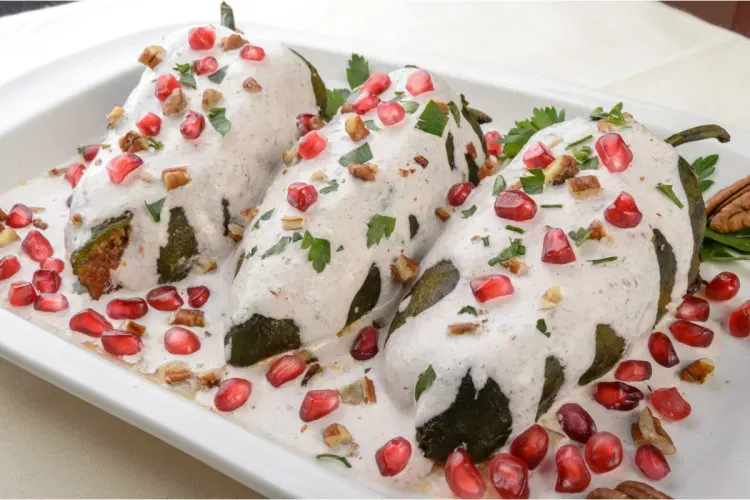
Stuffed poblanos in walnut sauce, the green, white and red dish of Puebla served in Mexico from August to September.
Ingredients
Instructions
The day before, put the walnuts in a bowl, cover them with ½ cup of the milk and enough cold water to submerge them, and refrigerate overnight. The next day, drain them and rub or pick off as much of the thin brown skin as you can; this keeps the sauce white and removes bitterness.
Roast the poblanos directly over a gas flame or under a hot broiler for 6–8 minutes, turning them, until the skin is blistered and blackened all over. Put them in a bowl, cover with a plate and let them steam for 15–20 minutes. Peel off the skin, make a lengthwise slit in each pepper and carefully remove the seeds and veins, leaving the stem attached.
Heat the 3 tablespoons of olive oil in a large skillet over medium heat. Add the onion and cook for about 5 minutes, until soft. Add the garlic and cook for 1 minute.
Add the pork and cook for 8–10 minutes, breaking it up with a spoon, until no pink remains and the juices run clear; the real safety test is 160°F on an instant-read thermometer. Pour in the 3 tablespoons of sherry and let it bubble for 2 minutes.
Add the tomato and cook for 5 minutes. Stir in the cinnamon, cloves, almonds, pine nuts, raisins and candied fruit. Add the peaches, apples and pears and cook for 5 minutes, stirring gently. Add the plantain and cook for 3–4 minutes more, until the fruit is tender but still holds its shape and most of the liquid has evaporated. Season with salt and pepper and let cool slightly.
Fill each pepper with the picadillo, as this sweet-and-savory filling is called, without overfilling, and close the slit with a toothpick.
If battering the peppers, heat the frying oil in a heavy, deep pan, filled no more than halfway, to about 350°F. Never leave the hot oil unattended, keep water away from it and have a lid nearby. Beat the egg whites with a pinch of salt until stiff, then gently fold in the yolks. Dust each pepper with flour, dip it in the egg batter and fry two at a time for 2–3 minutes per side, until puffed and golden all over with no wet batter left; the eggs are then cooked to 160°F. Drain on paper towels.
For the walnut sauce, put the peeled walnuts, cheese, the remaining ½ cup of milk, the cream, bread, sugar, 2 tablespoons of sherry and a pinch of salt in a blender. Blend until completely smooth, thick but pourable; add a little more milk if needed.
Remove the toothpicks and place one pepper on each plate. Cover it generously with the walnut sauce and sprinkle with the pomegranate seeds and parsley leaves. Serve the peppers warm or at room temperature, with the sauce cool.
Nutrition820
Notes
Chiles en nogada take time, so many cooks spread the work over two days: soak and peel the walnuts and make the filling on the first day, refrigerating it within 2 hours, then roast and stuff the peppers and make the sauce on the second. Reheat the filling until steaming hot, 165°F, before stuffing.
Fresh-crop walnuts, sold in late summer and fall, have thinner skins that peel more easily. Peeling is slow but worth it: unpeeled walnuts make a grayish, slightly bitter sauce.
Acitrón, the candied cactus traditionally used in the filling, comes from a protected species and is no longer legal to sell in Mexico. Candied pineapple, citron or squash gives a similar sweet bite.
The sauce contains uncooked sherry. For children or anyone avoiding alcohol, replace it with an equal amount of milk.
Refrigerate leftovers within 2 hours and use within 3–4 days, keeping the sauce separate. Reheat the peppers until they reach 165°F and serve with the cold sauce.
Allergy note: contains tree nuts (walnuts, almonds, pine nuts), milk and wheat, and eggs if battered.
Variations
Unbattered. Skip the eggs, flour and frying oil and serve the roasted, stuffed peppers as they are; both versions are served in Mexico. Without the batter, a serving has about 710 calories.
Pork and beef. Use ½ pound of ground pork and ½ pound of ground beef, or chop the meat by hand for a coarser filling.
Milder heat. Poblanos are usually mild, but an occasional one is hot; taste a strip after roasting and serve that pepper to someone who likes heat.
Source
Chiles en nogada come from Puebla, in central Mexico, and are eaten mainly in August and September, when walnuts and pomegranates are in season and the country celebrates its independence. The green parsley, white sauce and red pomegranate are said to stand for the Mexican flag.
A popular story says the nuns of the Santa Mónica convent in Puebla created the dish in 1821 for Agustín de Iturbide, the general who signed the treaty that ended the war of independence. Historians doubt it: a dish of fruit-filled chiles in walnut sauce seems to be older, it was first eaten as a sweet course, and the meat filling was added later.
Read more about the peppers in All about Mexican chile peppers.