
Oyster stuffing
An American classic from the days when oysters were cheap and everywhere. Soft bread, butter, celery and herbs, folded through with shucked oysters and their briny liquor, then baked until the top goes crisp. It tastes luxurious now, which is the opposite of how it started.
Ingredients
Instructions
To dry the bread, spread the cubes on a sheet pan and leave them uncovered overnight, or dry them in a 250°F oven for 30 to 40 minutes until firm and lightly crisp but not browned. They should feel dry right through. This is not optional — fresh bread turns to paste.
To prepare the oysters, tip them into a sieve set over a bowl and let the liquor drain through. Pour the liquor through a fine sieve or a coffee filter into a clean bowl to catch any grit, and set aside. Run your fingers over each oyster to check for shell fragments. Cut large oysters into two or three pieces; leave small ones whole.
Heat the oven to 350°F and butter a 9 by 13 inch baking dish.
T cook the aromatics, melt the butter in a large skillet over medium heat. Add the onion and celery and cook for 10 to 12 minutes, until soft and translucent but not coloured. Stir in the thyme and sage and cook for one minute more, until fragrant.
Put the dried bread in your largest bowl. Scrape in the vegetables along with all the butter from the pan, add the parsley, and toss well.
Measure the strained oyster liquor and top it up with stock to make 2 cups. Whisk in the eggs, the salt, a good grind of pepper and the cayenne if using. Pour over the bread and fold gently until evenly moistened. It should be damp throughout but not swimming — add a little more stock if any cubes are still dry.
Fold in the oysters last, gently, so they stay in pieces rather than breaking up.
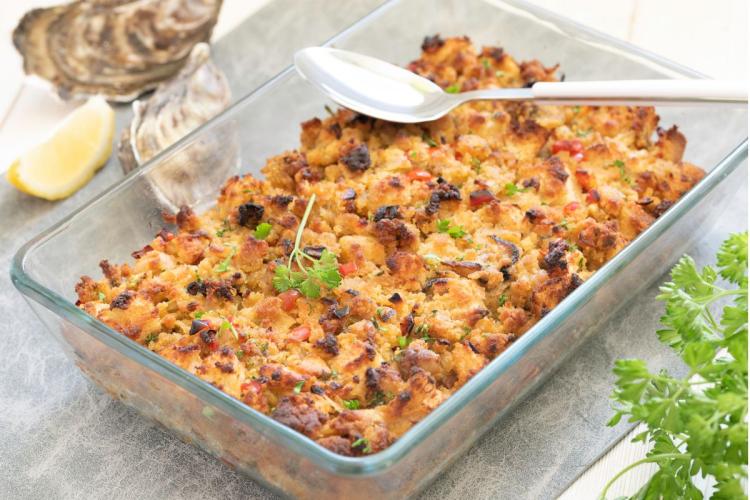
Transfer to the buttered dish without packing it down, and dot the top with a little more butter. Cover with foil and bake for 30 minutes, then uncover and bake a further 20 to 25 minutes, until the top is golden and crisp and the centre reads 165°F.
Rest for 10 minutes before serving.
Notes
Bake it separately, not inside the bird. Shellfish stuffing cooked in a cavity is a poor idea — it sits in the temperature danger zone for a long time before the centre catches up, and the oysters are ruined by then anyway. This is one stuffing where cooking in a dish isn't just the easier choice, it's the right one.
Buy shucked oysters in liquor, sold in tubs at the fish counter. Not canned, not smoked, and not oysters you shuck yourself unless you enjoy that sort of afternoon. Standard or select grade is ideal here; you don't need anything expensive, since these are going into a baked dish.
Strain the liquor properly. Grit is the one thing that ruins this dish, and it hides in the liquor rather than on the oysters. A coffee filter is slow but thorough.
Season at the end, not the start. Oyster liquor is salty and so is stock. Taste the moistened bread before it goes in the dish, and adjust then.
They shrink. The oysters will look generous going in and considerably less so coming out. If you want them to be the obvious point of the dish rather than a savoury background note, use two pints.
Make ahead. Assemble everything except the oysters up to a day in advance and refrigerate. Fold the oysters in just before baking, and add 10 minutes to the covered time if the dish is going in cold.
Variations
Cornbread base - The Southern and Gulf Coast version. Swap the white bread for dried cornbread cubes, as in corn bread stuffing, for the base and add a pinch more cayenne.
New England cracker style - Replace half the bread with crumbled common crackers or oyster crackers, which give a softer, more custard-like result. An older approach and still made in coastal New England.
With bacon - Six ounces, diced and crisped, with the fat used in place of some of the butter. Smoke and oysters get along very well.
With andouille - The Louisiana route, on a cornbread base. Assertive, and it does compete with the oysters — use fewer or accept the trade.
With leek and fennel instead of onion and celery, for something lighter and more aromatic.
Source
Oyster stuffing reads as an extravagance today. It began as the opposite.
Through the nineteenth century, American oysters were astonishingly abundant and correspondingly cheap. The beds of the Chesapeake and of New York harbour produced them on a scale that's hard to imagine now, and they were street food — sold from carts and cellar bars, eaten by the plateful by people who could afford very little else. They also travelled: packed in barrels and moved by rail, they reached inland tables through the cold months, which is precisely when the holiday roasts happen.
So oysters ended up in the stuffing for the ordinary reason that they were cheap, plentiful and in season. Over-harvesting and pollution then collapsed the beds through the late nineteenth and early twentieth centuries, and the price went the way it went. The dish stayed put, and quietly changed meaning around the ingredient.
Regional versions persist. New England leans on crackers, the Chesapeake keeps it simple with bread and butter, and the Gulf Coast works from cornbread with more heat. The one thing they share is the liquor — the strained juice from the oysters, used as part of the moistening liquid, which is where most of the flavour actually lives. A version made with drained oysters and plain stock is a different and much duller dish.