
Longevity noodles (Cháng Shòu Miàn)
Longevity noodles are one of China's most symbolic dishes. Served at Lunar New Year celebrations and birthday feasts, these extra-long wheat noodles represent wishes for a long, healthy life. The rule is simple and absolute: never cut or break the noodles. Their unbroken length is the whole point.
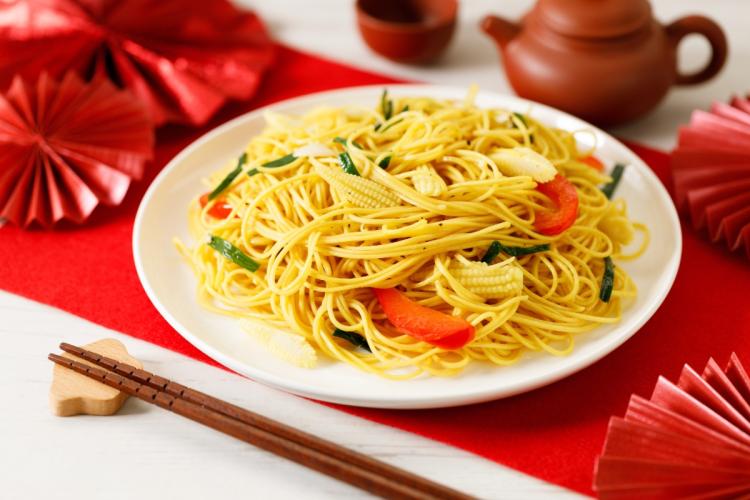
Unlike Italian pasta, which is cut into precise lengths, longevity noodles are kept as long as possible, sometimes a single noodle spans the entire bowl. In northern China, skilled cooks hand-pull one continuous strand. Home cooks typically use the longest dried noodles they can find. This recipe offers a stir-fried version with vegetables and savory sauce; satisfying, auspicious, and ready in 30 minutes.
Ingredients
Instructions
Prepare the sauce: Whisk together soy sauce, oyster sauce, sesame oil, sugar, and broth in a small bowl. Set aside.
Cook the noodles: Bring a large pot of water to a boil. Add the noodles and cook according to package directions until just al dente — typically 4-5 minutes. Drain carefully, keeping the noodles as intact as possible. Do not break them. Rinse briefly with cold water to stop cooking and prevent sticking. Toss gently with a splash of sesame oil.
Heat the wok: Place a wok or large skillet over high heat. Add vegetable oil and swirl to coat. When the oil shimmers, add garlic and ginger. Stir-fry for 30 seconds until fragrant.
Cook the vegetables: Add bell pepper, green onion and bamboo shoots. Stir-fry for 2 minutes. Add baby corn and cook another minute or two until slightly tender, cooked but still crisp.
Add the noodles: Carefully transfer the noodles to the wok, keeping them long. Pour the sauce over the noodles. Toss gently with tongs or chopsticks. Lift and fold rather than stir to avoid breaking the strands.
Finish and serve: Transfer to a serving plate, keeping the noodles as long and intact as possible. Garnish with sesame seeds. Serve immediately.
Notes
Look for dried Chinese wheat noodles, sometimes labeled "longevity noodles" or "yi mein" at Asian grocery stores. Dried spaghetti works in a pinch, but wheat noodles have the proper chew. Fresh Hong Kong-style noodles are another excellent option.
Everything about this recipe is designed to preserve the noodles' length. Cook them gently. Drain carefully. Toss with tongs, never stir aggressively. When plating, lift and drape rather than dump.
Slightly undercook the noodles when boiling — they'll finish cooking in the wok. Mushy noodles break easily and lose their satisfying chew.
A very hot wok prevents sticking and adds "wok hei" — that slightly smoky breath of the wok that defines great stir-fry. If using a regular skillet, work in batches to maintain heat.
Variations
Vary vegetables to your taste, adding or substituting. Carrots, cabbage or broccoli work well. Mushrooms are also great in stir fries.
Add sliced chicken breast, pork, shrimp, or tofu. Stir-fry the protein first, remove, then add back with the noodles.
Add 1-2 teaspoons of chili crisp or a sliced fresh chili to the stir-fry for heat.
Vegetarian or vegan: Substitute oyster sauce with vegetarian oyster sauce or hoisin. Use vegetable broth and add more mushrooms for depth.
Soup version: Skip the stir-fry. Serve cooked noodles in a rich chicken broth with bok choy, a soft-boiled egg, and sliced scallions. The noodles should be long enough to slurp dramatically.
Source
The tradition dates back over 2,000 years to the Han Dynasty. Legend says Emperor Wu of Han was obsessed with longevity after hearing that people with long faces lived longer. His advisors connected the word for "face" (面, miàn) with the word for "noodles" (also 面, miàn), and so the custom of eating long noodles for long life was born — proof that even ancient wordplay could create lasting traditions.
Food in Asia