
One of Egypt's great celebration dishes: young pigeon packed with smoky green wheat and warm spices, gently poached until tender, then fried until the skin turns crisp and mahogany. It takes some hunting to find the birds, and it is worth every phone call.
Ingredients
Instructions
Soak the birds. Put the squab in a bowl of cold water with the vinegar and a good pinch of salt, and leave for 10 minutes. This is standard Egyptian practice and takes the edge off any gaminess. Drain and pat dry.
Cook the freekeh. Rinse it in a sieve under cold water until the water runs clear. Bring 2 cups of water to a boil, add the freekeh, lower to a simmer and cook uncovered for about 15 minutes, until tender but still with some bite. Drain well and spread it out to cool.
Build the stuffing. Melt the butter in a skillet over medium heat. Cook the onion gently for 6 to 8 minutes until soft and translucent but not browned. Add the chopped livers and gizzards, raise the heat slightly, and cook another 3 to 4 minutes until they lose their raw colour. Stir in the cinnamon, allspice, salt and a good grind of pepper, and cook for 30 seconds more until fragrant.
Combine. Stir the onion mixture through the cooled freekeh. Taste it now — this is your only chance to correct the seasoning. It should taste good on its own.
Stuff the birds. Season the squab inside and out with salt and pepper. Pack the cavity of each loosely with stuffing, leaving room for it to swell — overfilling will split the skin. Close the openings with kitchen twine or a couple of toothpicks. Set any leftover freekeh aside to reheat later.
Poach. Bring 8 cups of water to a boil in a pot wide enough to hold both birds. Add the halved onion, bay leaves, cardamom, peppercorns and 1 tsp salt. Lower the birds in, reduce to a bare simmer, and cook for about 40 minutes, until a skewer slides easily into the thickest part of the thigh. Older or wild birds may need considerably longer — check at 40 minutes and keep going if the meat resists.
Dry them thoroughly. Lift the squab out with a slotted spoon, drain, and pat them completely dry with paper towels, inside the cavity as well. Wet skin will not crisp, and it will spit in the pan.
Fry. Heat the oil or ghee in a heavy skillet over medium-high heat. Fry the birds, turning them with tongs, for 8 to 10 minutes until the skin is evenly deep golden and crisp all over. Take your time getting the breast, back and both sides.
Serve. Rest for 5 minutes, remove the twine, and serve hot on a bed of the reserved freekeh, with lemon wedges and flatbread. A simple salad of tomato, cucumber and parsley makes a good accompaniment.
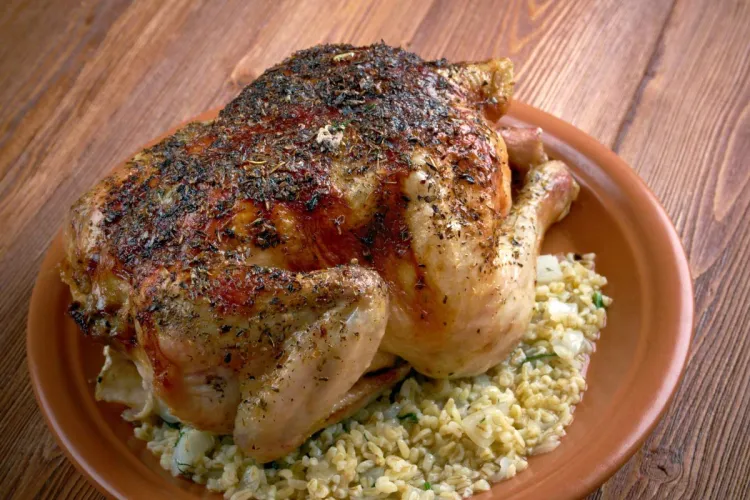
Notes
Where to find squab. Specialty butchers, online game suppliers, and many Chinese and Vietnamese markets, where they're a standard item. They usually arrive frozen; thaw overnight in the fridge. Ask for the giblets — some suppliers include them, and they make the stuffing considerably better.
Buy cracked freekeh, not whole. Whole freekeh takes 40 minutes or more and won't be ready in step 2. If whole is all you can find, cook it separately until tender before you start.
Don't skip the drying step. The difference between good and disappointing here is entirely about how dry the skin is before it hits the oil.
For extra-crisp skin, brush the poached, dried birds with a thin coat of plain yogurt before frying. It's a common Egyptian trick and it browns beautifully.
Make ahead. The stuffing can be made a full day in advance and refrigerated. Bring it back to room temperature before stuffing the birds.
Save the poaching liquid. It's a light, fragrant broth. Strain it and use it to cook the freekeh next time, or as the base for a soup.
Variations
Rice instead of freekeh. Equally traditional in Egypt, and the more common version in many households. Use short or medium-grain rice, cooked until just short of done.
Cornish game hen or poussin. The easiest substitute if squab defeats you. They're larger and milder, so increase the stuffing by half and add 10 to 15 minutes to the poaching. The flavour is gentler — squab is genuinely dark, almost livery meat, and nothing else quite replicates it.
With mastic. Mastic — mistika, the aromatic resin sold in Middle Eastern and Greek groceries — is a genuine Egyptian pantry ingredient, used in broths and in desserts, and some cooks add it to the poaching liquid. Use three or four small tears, crushed with a pinch of salt, and no more: it is piney and assertive, and a heavy hand makes the broth taste medicinal.
With nuts and fruit. Toasted pine nuts or slivered almonds folded through the freekeh, or a handful of soaked currants, for a more festive version.
Roasted finish. Instead of frying, brush the poached birds with butter or ghee and roast at 450°F for 12 to 15 minutes. Less crisp, but easier with more than two birds.
Cook in stock. Replace the poaching water with light chicken stock for a deeper result.
Source
Background and history
Stuffed pigeon — hamam mahshi — is one of the defining dishes of Egyptian cooking, the thing served at weddings, feasts and family gatherings, and the dish Egyptians abroad tend to miss most. Offering it is a gesture of hospitality: it takes real work, and everyone at the table knows it.
Egypt has been raising pigeons for thousands of years. Drive through the Nile Delta or the Fayoum and you'll see pigeon towers rising out of the fields — tall mudbrick structures honeycombed with nesting holes, some of them enormous. They were built both for the birds and for their droppings, which have manured Egyptian fields since antiquity. Pigeon is not exotic in Egypt. It's farmed, everyday, and deeply woven into the landscape.
The stuffing tells its own story. Freekeh is young green wheat, harvested while the grain is still soft, then set alight so the straw and chaff burn away while the moist kernels inside survive. What's left is rubbed clean — the Arabic farīk means "rubbed" — and dried, giving a grain that tastes distinctly of smoke and green wheat. It's an old technique from the eastern Mediterranean, and the usual explanation is that it began as a way to rescue a crop harvested early, whether from necessity or misfortune. Rice is just as traditional a filling in Egypt and many households prefer it, but freekeh is the version worth seeking out. Nothing else tastes like it.
The two-stage cooking method — poach, then fry — is the traditional approach and the reason the dish works. Simmering keeps the meat moist and cooks the stuffing through; the fry gives the skin the crispness that a wet-cooked bird would otherwise never get.