Dried cod, cured salmon, lamb and cabbage, brown cheese and a daily life built on bread: how Norway eats, from the Arctic to Christmas Eve.
Norwegian food starts with a problem. The country runs for more than a thousand miles toward the Arctic, most of it is mountain, and only a sliver of the land can be farmed. Summers are short and bright, winters long and dark. For most of its history the question in a Norwegian kitchen was not what to cook tonight but how to make the fish, the milk and the meat of one brief season last until the next.
The answers were drying, salting, smoking, curing and fermenting, and they are still the backbone of the cuisine long after North Sea oil made Norway one of the richest countries in the world. What follows is a guide to how Norwegians eat: the cod that paid for the country, the salmon that changed sushi, lamb and cabbage, the brown cheese that isn't quite cheese, a daily life built on bread, and a calendar in which every feast has its fixed dish.
The country behind the food
Norway is mostly coast. Counted around every fjord and island, its shoreline is one of the longest in the world, and a warm Atlantic current keeps the harbors free of ice far above the Arctic Circle. The cold, clean water offshore holds cod, herring, mackerel and shellfish in quantities the land could never match, and for a thousand years fish has been both dinner and the main thing Norway had to sell.
Inland the country is valleys and high plateaus. Grain ripens reliably only in the southeast and around Trondheim, so the old farming economy leaned on animals instead. Cows, goats and sheep were walked up to the seter, the summer mountain farm, to graze, and the milk was turned into butter and cheese on the spot.
Politics left a mark too. Norway was ruled from Copenhagen for some four centuries and then joined to Sweden until 1905, and for most of that time it was poor. Hundreds of thousands of Norwegians left for the United States, which is why lefse and lutefisk are still church-supper food in Minnesota and the Dakotas. In the far north the Sami, the indigenous people of the Arctic, kept a food culture of their own, built around the reindeer.
Cod, the fish that built the country
Every winter the Arctic cod called skrei swim down from the Barents Sea to spawn around the Lofoten Islands, and every winter Norwegians have been waiting for them. Fresh skrei is a seasonal treat, served simply with its liver and roe. Most of the catch, though, was always destined to be preserved, in one of three ways.
Tørrfisk, or stockfish, is the oldest. The cod are gutted, tied in pairs by the tail and hung on wooden racks to dry in the cold wind for two to three months. Nothing is added, not even salt. By the end the fish has lost most of its weight, is as hard as a board and keeps for years. Stockfish has been traded for more than a thousand years, it paid for much of medieval Bergen, and it is still shipped to Italy and Nigeria, where it is part of the local cooking.
Klippfisk, literally "cliff fish," is cod that is salted first and then dried, originally spread on the bare rocks of the shore. The trade grew up around the town of Kristiansund from the 1700s and sold to Spain, Portugal and later Brazil. The ships that came north to load it left something behind: in Norway bacalao means not the fish but the stew, klippfisk simmered with tomato, potato, onion, peppers and olive oil, as close to Mediterranean cooking as the traditional kitchen gets.
Lutefisk is the one visitors have heard about. Stockfish is soaked in water, then in lye, then in water again until it swells into something pale, translucent and quivering. It is baked or steamed and served with bacon and its fat, mushy peas and boiled potatoes. Norwegians eat it in the weeks before Christmas, argue about whether they like it, and eat it again the following year.
For a gentler introduction to Norwegian cod, try cod baked in milk.
Salmon, herring and the rest of the sea
Salmon was a river fish and a luxury until Norway began farming it in the fjords in the 1970s. The country is now the world's largest producer of farmed Atlantic salmon, and it changed how the rest of the world eats the fish. Raw salmon was not a sushi ingredient in Japan until a Norwegian trade campaign in the 1980s persuaded Japanese buyers to try it.
At home the classic preparation is gravlaks, salmon cured for a few days under salt, sugar and dill and sliced thin with a sweet mustard sauce. The name means "buried salmon," a memory of the days when the fish was preserved in the ground. Smoked salmon with scrambled eggs is the other standard, on the table at any celebration breakfast.
Beyond salmon, the everyday seafood includes:
- Sursild — pickled herring, in a plain sweet-sour brine or dressed with mustard, tomato or curry.
- Fiskesuppe — a creamy fish soup with salmon, cod, shrimp and root vegetables. Every coastal town has its own.
- Fiskekaker and fiskeboller — fish cakes fried in butter, and soft fish dumplings served in white sauce. Weeknight food, loved by children.
- Reker — cold-water shrimp, bought boiled from the boat and eaten in summer piled on white bread with mayonnaise and lemon.
- King crab — a newcomer. The crabs were released in Russian waters in the 1960s, walked west and are now a prized catch in the far north.
And then there is rakfisk: freshwater trout or char, salted and left to ferment for months, then eaten uncooked on flatbread with sour cream and raw onion. The mountain district of Valdres is its heartland. The smell is strong and the taste is milder than the smell suggests. Because it is never cooked, Norwegian health authorities advise pregnant women and anyone with a weakened immune system to leave it alone.
Lamb, pork and game
Norway's sheep spend the summer loose in the mountains, and the lamb that comes down in September is the best meat in the country. It goes into fårikål, which is exactly what its name says, "mutton in cabbage": lamb on the bone, wedges of cabbage, whole black peppercorns, water and salt, layered in a pot and simmered for hours. Radio listeners voted it the national dish in 1972, and when the government put the question to the public again four decades later, fårikål won again.
The everyday meat dish is kjøttkaker, flattened meatballs larger than the Swedish kind, served in brown gravy with boiled potatoes, stewed peas and lingonberry jam. Cured meat, spekemat, is the food of summer: salted and dried leg of lamb and cured ham, eaten with flatbread, sour cream and scrambled eggs.
Autumn is hunting season, and moose, deer and grouse all reach the table, usually with juniper, cream and wild mushrooms. A slice of brown cheese melted into the gravy is the cook's trick with game.
The west coast keeps one dish that tests visitors more than lutefisk does. Smalahove is a sheep's head, salted, smoked and steamed, served by the half before Christmas in the district of Voss.
Sami food in the north
The Sami have herded reindeer across northern Norway, Sweden, Finland and Russia for centuries, and reindeer is the center of their cooking. The meat is lean and mild, and nothing is wasted: it is roasted, dried, smoked, and the heart and tongue are delicacies.
Bidos is the dish for weddings and celebrations, a clear stew of reindeer, potatoes and carrots cooked slowly with very little else, so that the broth tastes of the meat. Alongside it come the gifts of the tundra: freshwater fish, and above all cloudberries, the amber berries that ripen in the northern bogs for a few weeks in late summer and are treasured across the whole country.
Potatoes, flatbread and porridge
The potato reached Norway in the 1700s and never left. Boiled potatoes come with almost every dinner, and cooking them well is treated as a skill, not an afterthought. Grated raw and mixed with barley flour, potatoes become raspeballer, heavy dumplings that go by a different name in every region and are served with salted meat, bacon and mashed rutabaga. There is potato soup as well, for the days in between.
Bread for most of history meant flatbrød, a paper-thin, crisp, unleavened sheet of barley or oat dough that could be stacked in the storehouse and kept for months. Its soft cousin is lefse, rolled thin and cooked on a griddle, then spread with butter, sugar and cinnamon and folded for coffee. The small potato version, lompe, is what a Norwegian hot dog is wrapped in.
Porridge was daily food and festival food both. Rømmegrøt is the rich one, made from sour cream cooked with flour until the butterfat runs out of it, eaten with sugar, cinnamon and cured meat on the side. Rice porridge is the Saturday lunch of childhood and a fixed part of Christmas, when an almond is hidden in the pot and whoever finds it wins a marzipan pig.
A country that runs on bread
Norwegians eat one hot meal a day. Dinner, middag, comes early, often before five o'clock. Breakfast, lunch and the late evening snack are all the same thing: slices of dense whole grain bread with something on top.
The something has a name, pålegg, which covers anything that can be laid on bread. The standards are cheese, liver pâté, salami, mackerel in tomato sauce, smoked cod roe squeezed from a tube, jam and brown cheese. Each slice gets one topping, laid on thin, and the sandwich stays open. For the more elaborate versions served to guests, see Scandinavian open sandwiches.
The purest form is the matpakke, the packed lunch. Three or four open slices are stacked with a square of paper between each one, wrapped, and carried to school, to the office or up a mountain. The habit goes back to the early twentieth century, when Oslo's schools swapped a hot meal for bread, cheese, milk and raw vegetables and found the children healthier for it. The lunch break at work is half an hour, and nobody expects the matpakke to be exciting. That is rather the point.
Brown cheese and the dairy tradition
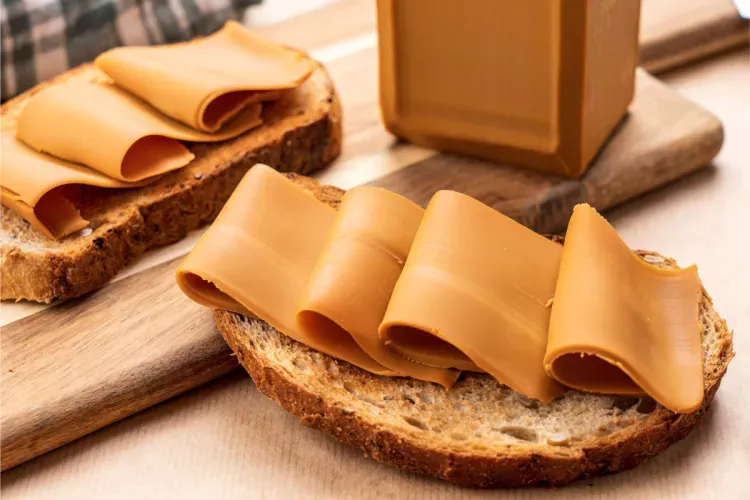
Brunost, brown cheese, is the taste Norwegians miss abroad. It is made by boiling whey with milk and cream for hours until the water is gone and the milk sugar has caramelized. Strictly speaking it is not cheese at all. The result is a dense, fudge-colored block that tastes of caramel with a tang underneath, sharper when goat's milk is used.
The modern version has a known inventor. In 1863 Anne Hov, a milkmaid on a mountain farm in the Gudbrandsdalen valley, added cream to the whey she was boiling down, and the richer cheese she got was soon selling in the capital. The older, softer form, a sweet whey spread called prim, is still eaten too.
Brunost is shaved, never cut, with a cheese slicer, the flat-bladed tool that is itself a Norwegian invention. It goes on bread, on crispbread and, best of all, on a warm waffle. The Norwegian waffle is thin, soft and heart-shaped, made with sour cream or cultured milk and often cardamom, and it is nothing like the crisp, deep-pocketed Brussels waffle. It is torn into hearts, topped with brown cheese or sour cream and jam, and eaten in the afternoon.
Sour cream, rømme, turns up everywhere, in porridge, on waffles, beside cured meat and with fish. The seter tradition also left a few fierce old cheeses made from soured skim milk, which most Norwegians respect more than they eat.
Coffee, cake and kos
Norwegians are among the heaviest coffee drinkers in the world, year after year near the top of the rankings with their Finnish neighbors. The coffee is black and filtered at home, and boiled in a kettle over a fire outdoors. It comes with something sweet, and the something sweet is usually a bolle, a soft wheat bun scented with cardamom, plain, studded with raisins or rolled with cinnamon and sugar. Bergen's cinnamon version is the skillingsbolle, named for the small coin it once cost.
The grander cakes mark occasions. Bløtkake, layers of sponge with whipped cream and berries, is the birthday and Constitution Day cake. Kransekake is a tower of chewy almond rings, stacked from large to small, for weddings, christenings and Christmas. At Christmas a proper household bakes seven kinds of cookies, and which seven is a family matter.
The word behind all this is kos, roughly coziness: candles, coffee, something baked, and people you like. A good deal of Norwegian eating is organized to produce it.
The calendar on the table
Norwegian feasts come with fixed menus, and on Christmas Eve the menu depends on where the family is from.
- Ribbe — roast pork belly with crackling, served with pork patties, sausages and sweet-sour cabbage. The choice of the east and of most of the country.
- Pinnekjøtt — salted, dried ribs of lamb, soaked and then steamed over birch sticks, with mashed rutabaga. The choice of the west and the north.
- Lutefisk or fresh cod — the fish tradition, strongest along the southern coast, and a survival of the days when Advent was a fast.
Whatever the main dish, there is rice porridge with its almond, a dark Christmas beer brewed for the season, a glass of aquavit, and often cloudberries folded into whipped cream to finish.
Constitution Day, May 17, belongs to the children, who parade and are allowed as many hot dogs and ice creams as they can manage. The adults start the day with a long breakfast of smoked salmon, scrambled eggs, cured meats and sparkling wine. Summer brings shrimp, new potatoes and strawberries; September brings the lamb, and fårikål with it.
What Norwegians eat on a Friday night
None of this means dinner in Norway is a museum. Ask a Norwegian family what they eat on Friday and the answer is very likely tacos. They arrived with American oil workers in Stavanger in the 1960s, spread through the supermarkets in the 1990s and became a national ritual: seasoned ground beef, soft tortillas and bowls of corn, cucumber, grated cheese and sour cream passed around the table. It is the Norwegian taco and nobody pretends it is Mexican.
Frozen pizza is the other modern staple, eaten in quantities few countries can match. And the pølse, the hot dog, is the national snack, bought at gas stations and kiosks, wrapped in a lompe or a bun and topped with ketchup, mustard, crisp fried onions or shrimp salad.
At the other end of the scale, Norwegian chefs have spent the past few decades taking the old pantry seriously again. Cod, scallops, wild berries, mountain lamb and the preserving techniques themselves are now the raw material of some of the most admired restaurant cooking in Europe.
Aquavit, beer and what else is poured
Aquavit is the national spirit. The Norwegian kind is distilled from potatoes, flavored with caraway and other herbs and seeds, and aged in oak casks, which turns it golden and rounds it out. Unlike the clear, ice-cold aquavits of Denmark and Sweden, it is sipped at room temperature, and its job is to cut through the fat of the Christmas table.
One style spends months at sea. The story goes that in 1805 a ship carried casks of aquavit from Trondheim to the East Indies, failed to sell them and brought them home, where the spirit was found to have improved. Casks have been sent across the equator and back ever since.
Beer is mostly pale lager, with the dark, strong Christmas beers the seasonal exception. In the western valleys, farmhouse brewing survived with its own family yeast strains, handed down for generations and now sought out by craft brewers around the world. The fjord district of Hardanger, where the orchards run down to the water, makes cider.
Alcohol is expensive and tightly regulated. Anything stronger than ordinary beer is sold only in state-run shops with short hours, which shapes how Norwegians drink: rarely on a weeknight, generously at a celebration. With everyday meals the glass holds water or milk.
Cooking Norwegian at home
Norwegian home cooking asks for very little that an American kitchen doesn't already have. The flavors are butter, cream, dill, cardamom, black pepper and good fish, and the methods are simple. A sensible place to start is with coffee: bake a tray of boller or a stack of lefse. For dinner, cod baked in milk with boiled potatoes is as Norwegian as a weeknight gets, and rice porridge will do for Saturday lunch.
You will find all of our Norwegian recipes in one place, and the neighbors on our food in Europe page.