Finns voted rye bread their national food. How Finland eats, from porridge and hot school lunch to coffee, pulla, salmon soup and sauna.
When Finland turned one hundred, it asked its people to choose a national food. They could have picked salmon, reindeer or a festive stew. Nearly forty thousand of them voted, and the winner was rye bread. That tells you most of what you need to know about Finnish food: it is plain, dark, a little sour, tied to the land, and loved without any fuss.
What follows is a guide to how Finns eat: the forest and lake pantry, the food day from morning porridge to the evening sandwich, the breads and pies, the everyday dishes, fish, the baking that goes with the coffee, the feasts of the year, and what is in the glass.
The country behind the food
Finland is forest and water. About three quarters of the country is covered in trees, there are lakes by the tens of thousands, and the north reaches well above the Arctic Circle. The summer is short and very bright, the winter long and dark, so the traditional kitchen relied on what could be stored: rye, barley and oats, root vegetables, salted and smoked fish, soured milk and dried bread.
The wild food is free to all. By long custom anyone may walk in the forest and pick berries and mushrooms, and Finns do it by the bucket. Bilberries, lingonberries, cloudberries, chanterelles and ceps fill freezers every autumn.
History shows on the plate too. Finland was part of Sweden for some six centuries and then a grand duchy of the Russian Empire until 1917, and it kept the best of both kitchens. From the west came meatballs, pickled herring, crispbread and the Thursday pea soup. From the east came pies and pasties, slow oven stews, sour rye bread, mushrooms, pancakes with roe and the Easter cheese dessert. In Lapland, the Sami built a food culture around reindeer.
How the Finnish food day works
Finns eat early, drink coffee all day and sit down to two warm meals. The rhythm is easy to follow.
Breakfast (aamiainen)
Breakfast is savory and solid. The standards are porridge, usually oatmeal with berries or a spoonful of jam and a pat of butter, and an open sandwich of rye bread with butter, cheese, cold cuts and a slice of cucumber or tomato. A Karelian pasty with egg butter is a favorite. There is coffee, and for the children milk.
Lunch (lounas)
Lunch is early and hot. Workers eat at eleven or twelve, and school canteens start serving as early as half past ten.
Every schoolchild gets a free cooked lunch every school day. The law was passed in 1943, the meals have been universal since 1948, and Finland describes itself as the first country in the world to do it. Workplaces and universities follow the same pattern with canteens and lunch restaurants.
The format is fixed: one main course, a salad buffet, bread with butter, and water, milk or a mild table beer. The main course may be fish or meat with boiled potatoes, a casserole, or a soup, which in Finland is a full meal in a big bowl and never a starter. On Thursdays the soup is pea soup, followed by an oven-baked pancake with jam, a custom shared with Sweden.
Coffee breaks (kahvitauko)
The working day has two coffee breaks, in mid-morning and mid-afternoon, and many labor agreements protect them. Coffee comes with something baked, most often a cardamom bun. An afternoon coffee at home, with several things on the table, is how Finns entertain.
Dinner (päivällinen)
Dinner is early, often around five, soon after work and school. It is a single warm course eaten at home: meatballs with mashed potatoes, a macaroni casserole, fried fish, sausage sauce, or pasta, chicken and rice dishes from the wider world. Potatoes are the traditional side, and there is bread on the table and milk or water in the glass.
The evening snack (iltapala)
Because dinner is so early, there is a small meal before bed with a name of its own. It is usually a sandwich, yogurt or a bowl of soured milk, with tea.
Saturday, sauna and candy
Saturday is traditionally sauna day, and the sauna has its own food: sausages, heated on the stove or grilled over a fire afterward and eaten with mustard and a cold beer. Saturday is also candy day for children. Finns are great candy eaters, and their passion is salmiakki, salty licorice flavored with ammonium chloride, which most foreigners try exactly once.
Street food and snacks
The snack bar of Finnish life is the grill kiosk, open late, selling sausages, burgers and lihapiirakka, a deep-fried pasty filled with ground meat and rice, split and loaded with relish and mustard. In summer the market squares take over with fried fish, new peas eaten from the pod, berries and coffee.
Rye bread, pies and porridge
Ruisleipä, rye bread, is the national food by popular vote. It is made from whole rye flour with a sourdough starter and nothing sweet, so it is darker, denser and more sour than the rye of its neighbors. Bakers keep the starter alive from batch to batch, in some families for generations. One old form is a flat round with a hole in the middle, made to be hung on a pole and dried for winter. Eaten fresh with butter, it goes with everything.
The other icon is the karjalanpiirakka, the Karelian pasty: a thin, crimped rye crust around a filling of rice porridge, brushed with butter and topped with chopped egg mixed into butter. It comes from Karelia in the east and is eaten all over the country, at breakfast, with coffee and from every supermarket bakery.
The east also gave Finland kalakukko, a whole loaf of rye baked for hours with small fish and pork sealed inside, the packed lunch of earlier centuries. Porridge, of oats, barley, rye or rice, is everyday food, and whipped berry porridge is a favorite dessert.
The everyday dishes
Finnish home cooking is gentle in flavor. The seasonings are salt, white pepper, allspice, bay leaf, dill and onion, and cream and butter do the rest. The dishes every Finn grew up on:
- Karjalanpaisti — Karelian stew: pork and beef, sometimes lamb, with onions, allspice and bay, left in a slow oven for hours. It came second in the national food vote.
- Lihapullat — meatballs in brown cream sauce with mashed potatoes and lingonberry jam.
- Makaronilaatikko — a baked casserole of macaroni and ground beef set with egg and milk, eaten with ketchup. School lunch at its most loved.
- Kaalilaatikko — cabbage casserole with ground meat and rice, sweetened with a little syrup and served with lingonberries.
- Hernekeitto — thick green pea soup with pork and mustard, the Thursday meal.
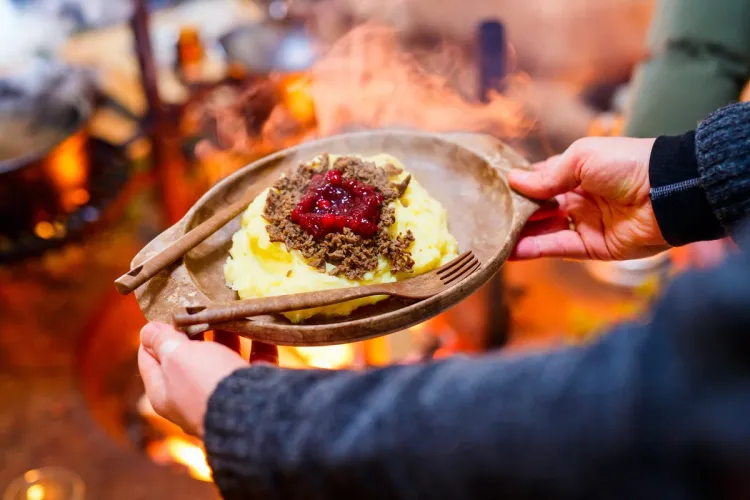
- Poronkäristys — sautéed reindeer from Lapland: thin shavings of meat cooked soft with butter and onion, served on mashed potatoes with lingonberries.
- Mustamakkara — the black sausage of Tampere, made with blood and barley and eaten hot from a market stall with lingonberry jam.
Potatoes come with nearly all of it. In June the first new potatoes are an event, boiled with dill and eaten with butter and herring. For a richer treatment, see our Finnish creamy potatoes.
Fish from lake and sea
With that much water, fish is everyday food. Lohikeitto, salmon soup, is the dish visitors remember: chunks of salmon, potatoes, carrots and leeks in a creamy broth, finished with a great deal of dill and eaten with rye bread.
The lakes give muikku, vendace, a small silver fish that is rolled in rye flour, fried crisp in butter and eaten whole. The Baltic gives small herring, fried, pickled or baked. Salmon and whitefish are also cured with salt and sugar, or smoked over alder, and served on dark bread. Crayfish have a late-summer season of their own, eaten at long tables with dill, toast and schnapps.
Dairy and the cheese that squeaks
Finland is one of the great dairy countries. Milk is drunk with meals by adults as well as children, and so is piimä, a tart cultured buttermilk. Breakfast and the evening snack lean on yogurt, quark and viili, a mild soured milk with a stretchy texture.
The cheese to know is leipäjuusto, "bread cheese": a flat round of fresh cow's milk cheese that is baked until it is spotted brown. It squeaks against the teeth, and it is served warm with cloudberry jam. In the north, cubes of it are dropped into a cup of hot coffee.
Coffee, pulla and the baking tradition
Finns drink more coffee per person than anyone else in the world. It is light-roasted and filter-brewed, mild enough to drink by the potful, and it is offered to every guest. Refusing a cup is a little rude.
What goes with it is pulla, a soft, sweet wheat bread scented with cardamom, baked as a braided loaf or as buns. Its best-known form is the korvapuusti, a cinnamon roll whose name means "slapped ears," after its squashed shape. A proper coffee table also holds a plain cake and several kinds of cookies; our Finnish cookie sticks belong to that tradition.
Berries make the desserts. Bilberry pie is the national favorite, and there are lingonberry and cloudberry versions of almost everything.
The calendar on the table
Each Finnish holiday comes with its own pastry or dish, and Finns wait for them all year.
- Runeberg's Day — February 5, the birthday of the national poet, marked with a small almond cake flavored with rum or arrack and topped with raspberry jam.
- Shrovetide — after sledding, pea soup and laskiaispulla, a cardamom bun filled with whipped cream and either jam or almond paste. Which filling is correct is a national argument.
- Easter — mämmi, a dark, baked pudding of rye and malt eaten cold with cream and sugar, and pasha, a rich molded dessert of quark from the Orthodox east. Roast lamb is the main dish.
- May Day (Vappu) — a spring picnic with sima, a lightly sparkling lemon drink, sugared doughnuts and tippaleipä, a crisp nest of fried batter.
- Midsummer — new potatoes with dill and butter, herring, smoked salmon, grilled sausages and strawberry cream cake, at the lake cabin.
- Autumn — mushrooms, lingonberries and game, with moose stew the hunter's reward.
- Christmas Eve — rice porridge with a hidden almond in the morning. In the evening comes the Christmas table: cured and pickled fish, a beet salad, baked casseroles of rutabaga, carrot and potato, and a slow-roasted ham with mustard. Afterward there are star-shaped pastries filled with prune jam, ginger cookies and glögi.
What Finns drink
Coffee
Coffee comes first, at breakfast, at both coffee breaks, after meals and in the evening. Filter coffee is still the standard, though espresso drinks have arrived in the cities.
Milk, juices and home brews
Milk and buttermilk are mealtime drinks. Berry juices are everywhere, from bilberry and lingonberry to sharp orange sea buckthorn, and in autumn there is apple juice from the orchards of the southwest.
Two traditional drinks are made at home. Kotikalja is a dark, malty, barely alcoholic table beer that was once the everyday drink with meals and is still poured in lunch restaurants. Sima is the May Day drink, made from water, lemon, sugar and a pinch of yeast, with raisins that float to the top when it is ready.
Beer and sahti
Beer is the most popular alcoholic drink, and most of it is pale lager, with a lively craft scene in the cities. The old Finnish beer is sahti, a strong, cloudy, sweetish farmhouse ale of barley and rye, traditionally filtered through juniper twigs. It has been brewed on farms for centuries and has protected status in the European Union.
The long drink, spirits and glögi
The long drink, or lonkero, is a Finnish original. It is gin mixed with grapefruit soda, created for the Helsinki Olympics of 1952 so that bartenders could serve crowds quickly, and Finns liked it too much to let it go. It is sold ready-mixed in cans.
The traditional spirit is a clear grain vodka, drunk ice cold in small glasses with fish, crayfish and at celebrations. Salty licorice finds its way into the shot glass as well. In winter the drink is glögi, hot spiced berry juice or wine with almonds and raisins.
Wine and spirits are sold in state-run shops, a system that dates from the end of prohibition in the 1930s. Beer and other mild drinks are sold in supermarkets.
The Finnish table today
The modern Finnish kitchen is as international as any, and pizza, kebab, sushi and tacos are ordinary weeknight food. At the same time, Finnish cooks have turned back to their own pantry. Wild herbs, mushrooms, lake fish, rye, oats and berries are the pride of the restaurant kitchen, and oats in particular have become a modern Finnish export in the form of oat milk and oat-based foods.
Cooking Finnish at home
The Finnish flavors are easy to find in an American kitchen: dill, cardamom, rye, butter, cream and berries. Start small, with Finnish creamy potatoes next to a piece of salmon, or bake Finnish cookie sticks for a coffee table. A plate of open sandwiches on dark rye is as close to a Finnish breakfast as you can get without a plane ticket.
You will find all of our Finnish recipes in one place, and the neighbors on our food in Europe page.