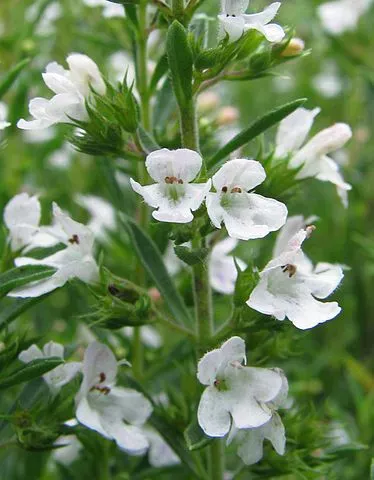
Savory is often one of the herbs in herbes de Provence. There are two main varieties, winter savory and summer savory. Summer savory is milder than winter savory.
Savory goes well with beans, peas and lentils, and in Germany it is known as the bean herb.
How to identify savory
Winter savory is a small, stiff-stemmed perennial subshrub with small leaves, similar to thyme in appearance. It produces small white to pale purple flowers in summer.
Summer savory is a tender annual with a single, widely branching stem and narrow leaves. It produces small lilac, pink or white flowers in summer and has a hot, peppery scent.
How to use and store savory
Summer savory adds spice to your favorite meats and vegetables, and it is used in sausages and stuffings.
Use winter savory sparingly in soups and meat or fish dishes. It enhances the flavor of beans, peas and lentils.
Cooking with savory
Use summer savory in a stuffed pork roast and winter savory with roasted zucchini.
Savory substitutions: if a recipe calls for savory and you don't have it, replace 1 tablespoon chopped fresh savory with:
- 1 teaspoon dried savory
- 1 teaspoon chopped fresh thyme plus 1 teaspoon chopped fresh mint, which varies the flavor
- 1 to 2 teaspoons chopped fresh sage, which varies the flavor
- 1 teaspoon dried herbes de Provence, which adds other flavors
Unlike most herbs, savory gives its best flavor when cooked with the food, rather than added at the end.
Experiment
Use savory the way you would use sage. Add it to salads, stewed vegetables or potatoes. Savory goes well with poultry and game birds, and it flavors tomatoes and green salads too.