
The sándwich cubano is six things pressed flat: Cuban bread, roast pork, sweet ham, Swiss cheese, dill pickles and yellow mustard. There is no lettuce, no tomato and no mayonnaise. What turns it from a stacked sandwich into a Cuban one is the press — the whole thing is flattened on a hot plate until the cheese runs, the pork warms through and the crust goes thin and brittle.
Ingredients
Instructions
Split each length of bread lengthwise without cutting all the way through, so the two halves stay hinged. Open it out flat.
Spread mustard over the cut face of the bottom half. Lay on the pork first, then the ham, then the cheese, then the pickles, keeping the layers even and flat rather than piled in the middle. Close the sandwich.
Butter the top and bottom crusts generously. This is what browns, and a dry crust will scorch before the inside warms.
Heat a heavy skillet or a flat griddle over medium heat. Lay the sandwiches in and put a second heavy pan on top, pressing down firmly. Weight the top pan with a couple of cans if it is not heavy on its own.
Cook for 3–4 minutes, until the underside is golden and the sandwich has compressed to about half its original height. Turn it, replace the weight, and cook for another 3–4 minutes. The sandwich is ready when the cheese has melted to the edges and the pork is heated through to 165°F.
Cut each one in half on a long diagonal and eat it straight away, while the crust is still brittle.
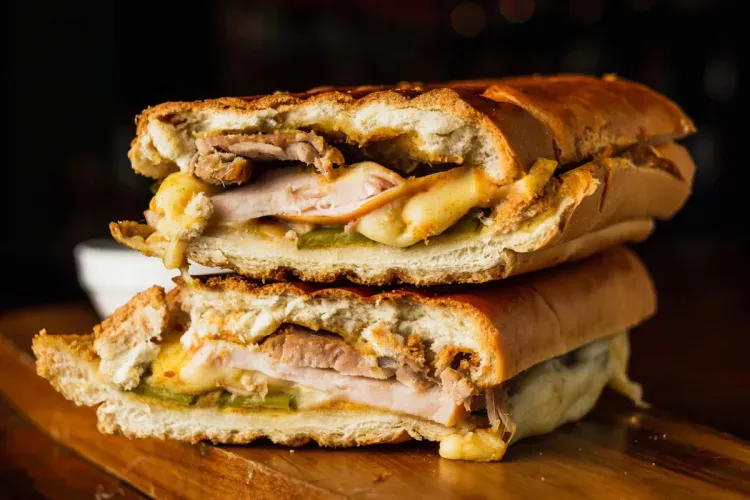
Nutrition750 estimated calories per serving
Notes
Before starting, make the pork. The sandwich is built on Cuban mojo roast pork — lechón asado — and the garlic and sour orange marinade is most of what the filling tastes of. Leftovers from a Sunday roast are the traditional source and the best one. Plain roast pork or sliced deli pork will do at a pinch, but the sandwich comes out noticeably flatter.
Let the pork and the ham come to room temperature before building. Cold meat straight from the refrigerator will leave the middle cool by the time the outside is as dark as it should be.
Cuban bread is the hard part outside Florida and the Northeast. It is a long, soft-crusted white loaf made with lard, closer to a baguette in shape but nothing like one in texture — the crust is thin and papery rather than crisp, which is what allows it to press flat without shattering. A soft Italian loaf or a French-style sandwich roll is the best substitute. A baguette is the worst: too narrow, too crusty, and it fights the press.
A sandwich press or panini grill works, but a grooved press leaves stripes that a plancha would not. A heavy skillet with a second pan on top gives the flat, even compression the sandwich is supposed to have.
Press harder than feels reasonable. The sandwich should come out about half the height it went in. An underpressed cubano is just a toasted sandwich.
Build it in the order given — pork against the mustard, cheese above the meat — so the melting cheese runs down into the pork rather than straight into the bread, which turns it soggy.
Leftover sandwiches do not keep well, but the components do. Refrigerate the sliced meats within 2 hours and use within 3–4 days.
Variations
Medianoche. The same filling on pan suave, a soft sweet egg bread close to challah, pressed the same way. It takes its name — midnight — from the Havana nightclubs where it was eaten after the shows, and it is sweeter, softer and slightly smaller than the cubano.
Tampa style. Add a layer of Genoa salami with the ham. Tampa is the one place where this is standard rather than a liberty, and the city's sandwich has been built this way since at least the 1930s.
With a fried egg. Common in Cuba as a breakfast version. Cook the egg to 160°F, with no liquid egg remaining, and lay it in with the cheese.
Source
The sandwich grew out of the mixto, the mixed sandwich of cold meats and cheese sold in Cuban cafés, and researchers who went looking for its origins concluded that Havana conceived it before Florida refined it. The food historian Andrew Huse put it as Havana conceiving the sandwich and Tampa curating it for decades afterward.
It traveled with the cigar industry. Between 1890 and 1950 Tampa held the largest Cuban community in the United States, and workers moving between Havana, Key West and Ybor City carried the sandwich with them. Tampa's version settled into its own shape by the 1940s, with Genoa salami layered in alongside the ham — usually credited to the Italian families who lived alongside the Cuban and Spanish ones in Ybor City, though Cuban records from the 1950s show salami on the island too, which complicates the tidy version of that story. Miami, which received the larger wave of Cuban exiles after 1959, kept the sandwich without the salami and is generally credited with the hot iron press that gives it its thin, crackling finish.
Pressing itself is not a Florida invention. The medianoche, eaten in Havana's nightclubs long before the exodus, was pressed the same way on sweeter bread.
What all the versions agree on is what stays out. Lettuce, tomato and mayonnaise belong to the Key West "Cuban mix" and are rejected in Tampa and Miami alike — a rare point of agreement between two cities that have argued about this sandwich for a century, to the point that Tampa's City Council voted its own version the city's signature sandwich in 2012.