How Sweden eats: fika, the hot dish of the day, Thursday pea soup, cozy Friday and Saturday candy, plus meatballs, herring and snaps.
Sweden has a name for almost every occasion on which people eat. Fika is the coffee break with something baked. Dagens rätt is the hot dish of the day at lunch. Fredagsmys is the cozy Friday night on the sofa, lördagsgodis is the candy that waits for Saturday, and the smörgåsbord is the one the rest of the world borrowed. Swedish food is easiest to understand through these rituals, because the dishes are simple and the customs around them are precise.
What follows is a guide to how Swedes eat: the food day from breakfast to the evening sandwich, the everyday classics, herring and the cold table, bread and dairy, the buns and cakes of fika, the feasts of the year, and what is in the glass.
The country behind the food
Sweden is long. It runs nearly a thousand miles from the wheat fields of the far south to the Arctic, and most of it is forest, with tens of thousands of lakes and a coast on two seas. The growing season is short, so the old kitchen was built on keeping food: fish pickled, cured, dried, smoked and fermented, pork salted, milk soured or turned into cheese, bread baked hard enough to store for months.
The forest is part of the pantry. By long custom anyone may walk in the countryside and pick wild berries and mushrooms, whoever owns the land, and Swedes do. Lingonberries, blueberries, cloudberries and golden chanterelles go into jam, soup, sauce and the freezer.
The flavors are dill, allspice, white pepper and mustard on the savory side, and cardamom, cinnamon and saffron in baking. What surprises visitors is the sweetness. Herring is pickled with sugar, everyday bread is often sweetened with syrup, and tart lingonberry jam sits on the dinner table next to the meat.
How the Swedish food day works
Swedes eat early and, unlike their Danish and Norwegian neighbors, they eat two hot meals a day. Coffee breaks divide the working day, and the week has its own fixed points.
Breakfast (frukost)
Breakfast is an open sandwich: crispbread or soft bread with butter, sliced cheese, ham, cucumber or bell pepper. A boiled egg is often dressed with smoked cod roe paste squeezed from a tube, a taste Swedes learn in childhood. The other standard is a bowl of filmjölk, a mild, drinkable soured milk, with cereal or muesli. On cold mornings there is oatmeal with milk and lingonberry jam. Adults drink coffee.
Lunch
Lunch starts as early as eleven and it is a cooked meal. Every schoolchild is served a free hot lunch, and has been for generations. Adults eat out or bring a matlåda, a lunchbox of last night's dinner to reheat at work.
Restaurants offer dagens rätt, the dish of the day, at a fixed price that usually covers a salad buffet, bread, a drink and coffee. It is the best way to taste Swedish home cooking, and it is the main meal of the day for many people.
Thursday lunch has been the same for centuries: ärtsoppa, yellow split pea soup with salt pork and a spoonful of mustard, followed by thin pancakes with jam and whipped cream. The custom goes back to the Middle Ages, when a filling Thursday meal came before the Friday fast, and it is still served in schools, in the army and in lunch restaurants across the country.
Fika
Fika is coffee with something sweet, taken with other people. Many workplaces schedule it twice, in mid-morning and in mid-afternoon, and skipping it is noticed. The word is thought to be an old slang reversal of kaffi, coffee. Children have their own version after school, a sandwich and a glass of milk.
Dinner (middag)
Dinner is early too, usually around six, and it is hot again. A weeknight dinner is one course, eaten at home: meatballs, fried sausage with creamed macaroni, baked fish, or just as often pasta, a stir-fry or a stew from somewhere else in the world. Potatoes are the traditional side, water or milk the drink.
The evening sandwich
Because dinner is early, many Swedes have a small late meal before bed: a cup of tea and an open sandwich, or a bowl of soured milk.
Friday and Saturday
Friday night is fredagsmys, "cozy Friday": the family at home in front of the television with easy food. The phrase caught on around 1990 and the food, more often than not, is tacos, served Swedish style with ground beef, soft tortillas and bowls of cucumber, corn, peppers and sour cream. Chips and dip follow.
Saturday is for lördagsgodis, Saturday candy. In the 1950s health authorities advised parents to save sweets for one day a week to protect children's teeth, and the habit stuck. The advice came out of dental research carried out on hospital patients without their consent, which Sweden now remembers as a scandal. The custom it produced is a cheerful one. Supermarkets have whole walls of pick-and-mix bins, and Swedes are among the biggest candy eaters in the world, with a special loyalty to salty licorice.
Street food and snacks
The classic stop is the sausage kiosk. A hot dog comes in a bun or, better, as a tunnbrödsrulle: a soft flatbread rolled around the sausage with mashed potato, crisp onion and shrimp salad. The neighborhood pizzeria is the other fixture, and its best-known invention is a pizza topped with kebab meat and garlic sauce.
Husmanskost, the everyday classics
Husmanskost means plain home cooking, the food of farms and working households, and it is what a dish of the day usually is. The classics:
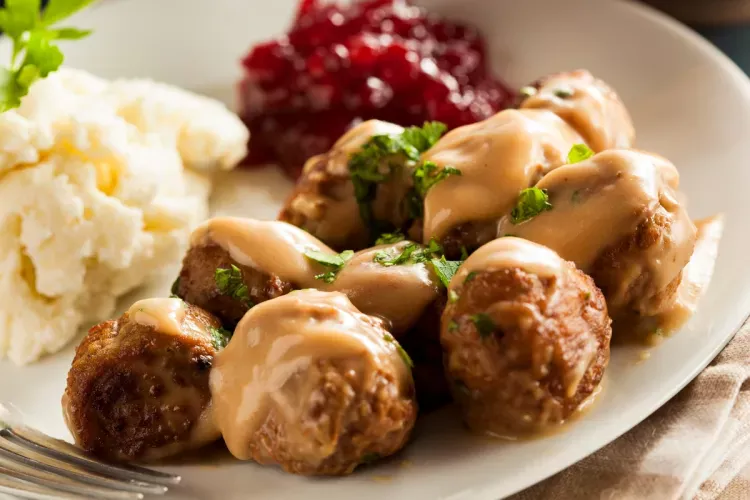
- Köttbullar — small meatballs of beef and pork, seasoned with onion and allspice, served with cream gravy, potatoes, lingonberry jam and quick-pickled cucumber. A Swedish furniture chain's cafeterias made them famous worldwide.
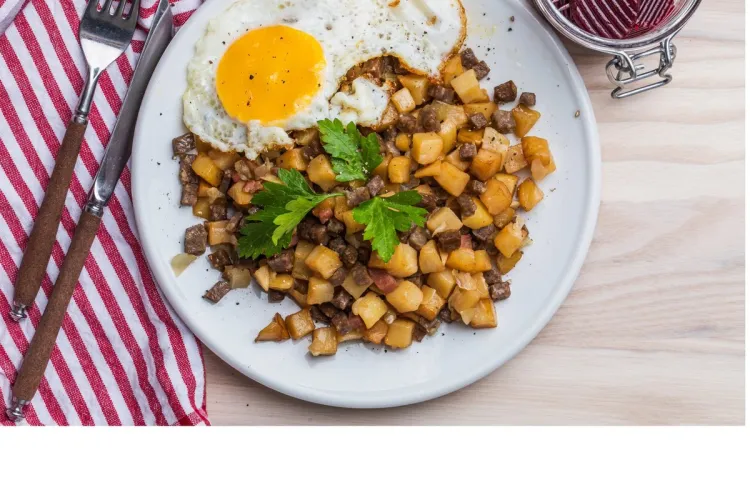
- Pytt i panna — diced potatoes, onion and leftover meat fried together, topped with a fried egg, with pickled beets on the side.
- Raggmunk — crisp potato pancakes with fried salt pork and lingonberries.
- Kåldolmar — cabbage leaves rolled around ground meat and rice. The usual story is that the idea came home from the Ottoman Empire with King Charles XII in the early 1700s, which is why they keep the Turkish word dolma.
- Falukorv — a thick, mild smoked sausage named for the mining town of Falun, sliced and fried, baked with mustard and cheese, or cut into strips in a creamy tomato sauce over rice.
- Janssons frestelse — "Jansson's temptation": a gratin of potatoes, onions and cream with spice-cured sprats, which Swedes confusingly call anchovies.
- Kroppkakor and palt — potato dumplings stuffed with salt pork, the first from the south, the second from the north.
- Kalops — beef stewed slowly with onions, allspice and bay leaves, eaten with potatoes and pickled beets.
- Blodpudding — black pudding, sliced, fried and eaten with lingonberry jam, a school lunch memory for every Swede.
Herring, salmon and the cold table
Herring is the fish of Sweden. Sill is pickled in a sweet, spiced brine and then flavored with onion, mustard, dill or a dozen other things, and no holiday table is laid without several kinds. It is eaten with boiled new potatoes, sour cream, chives, crispbread and a wedge of sharp cheese. The smaller herring of the Baltic is fried in butter and served with mashed potatoes.
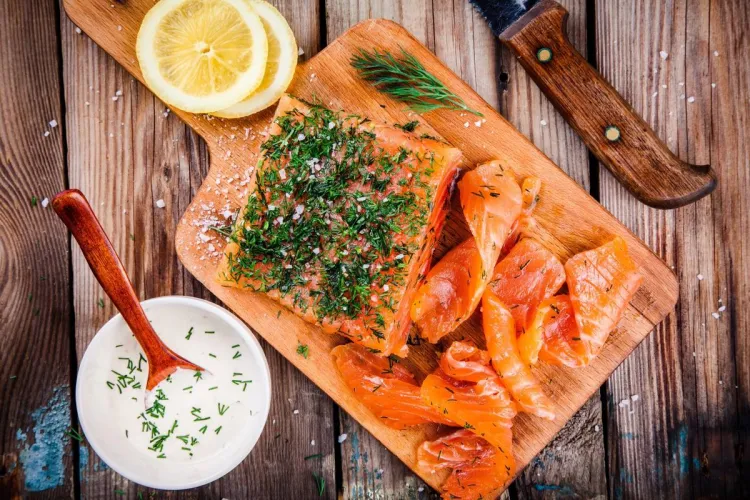
Gravlax is salmon cured for a few days with salt, sugar and dill, sliced thin and served with a sweet mustard and dill sauce. Shrimp are the west coast's pride, heaped on an open sandwich with egg and mayonnaise, or mixed with dill and mayonnaise on butter-fried toast. For a party there is smörgåstårta, "sandwich cake," layers of bread and creamy fillings decorated like a dessert.
Two fish belong to late summer. Crayfish are boiled with dill and eaten cold at outdoor parties in August. And in the north, cans of surströmming, fermented Baltic herring, are opened, outdoors and with care, because the smell is famous. It is eaten rolled in flatbread with potato, raw onion and sour cream, and it tastes far milder than it smells.
All of this comes together in the smörgåsbord, literally "sandwich table," a buffet with rules. Guests go up several times with a clean plate each time: herring first, then other cold fish, then cold meats, then the small hot dishes, and dessert last. To build the simpler everyday version at home, see Scandinavian open sandwiches.
Bread and dairy
Knäckebröd, rye crispbread, is on the table at nearly every meal. It was traditionally baked as a large round with a hole in the middle, so the breads could be threaded on a pole under the ceiling and kept through the winter. The north has tunnbröd, a thin flatbread that is baked either soft or crisp. Soft loaves, called limpa, are made with rye and often sweetened with syrup and scented with fennel or orange.
Sweden is one of the great milk-drinking countries. Besides filmjölk there is firm, aged cow's milk cheese, eaten in thin slices cut with a cheese slicer. There is etiquette to it: the block must be kept level, and leaving a slope in the cheese is bad manners.
Fika, buns and cakes
The baked side of fika is a repertoire of its own, and Swedes are serious home bakers. The center of it is the kanelbulle, the cinnamon bun: a soft cardamom dough rolled with butter, sugar and cinnamon and finished with pearl sugar instead of icing. Its grown-up cousin is the cardamom bun. Our Swedish coffee cakes come from the same tradition.
Around the bun there is more:
- Sju sorters kakor — "seven kinds of cookies," the number a proper hostess was expected to offer with coffee. Fewer looked stingy and more looked like showing off.
- Chokladboll — an unbaked ball of oats, butter, cocoa and coffee rolled in coconut, the first thing Swedish children learn to make.
- Prinsesstårta — princess cake: sponge, jam, vanilla cream and a dome of whipped cream under a sheet of green marzipan.
- Semla — a cardamom bun filled with almond paste and whipped cream, made for Shrove Tuesday and eaten all through late winter.
- Lussekatter — S-shaped saffron buns with raisins, baked for St. Lucia's Day on December 13.
- Våfflor — thin, crisp, heart-shaped waffles with jam and whipped cream, which have their own day on March 25.
Desserts are homely. There are pancakes with jam, a baked curd cake served warm with cream, and fruit soups of rose hip or blueberry that are drunk hot from a mug as often as eaten with a spoon. At Christmas there is rice pudding, with an almond hidden in the pot.
The calendar on the table
Swedish holidays repeat the same cold table with seasonal changes, and each has its fixed dishes.
- Easter — eggs, herring, salmon and lamb, with paper eggs full of candy for the children.
- Midsummer — celebrated on a Friday in late June with pickled herring, new potatoes boiled with dill, sour cream and chives, and the first strawberries, usually as a cream cake. Snaps and songs go with it.
- The crayfish party — an August evening outdoors, with paper lanterns, silly hats, crayfish, cheese pie, bread and more songs.
- St. Martin's Eve — November 10 in the far south, with roast goose.
- Advent and Lucia — saffron buns, ginger snaps and glögg throughout December.
- Christmas Eve — the julbord, the Christmas version of the smörgåsbord. Its centerpiece is the Christmas ham, glazed with mustard and breadcrumbs, surrounded by herring, gravlax, meatballs, small sausages, Jansson's temptation and red cabbage, with rice porridge to finish.
What Swedes drink
Coffee
Swedes are among the ten heaviest coffee-drinking nations in the world. The coffee is filter-brewed, strong and usually black, and a second cup is expected. In the far north it is still sometimes boiled in a kettle and poured over cubes of soft cheese.
Milk and soft drinks
Milk is a mealtime drink for adults as well as children. Lunch restaurants also pour lingonberry drink, a tart, pale red cordial, and a very weak table beer. At home there is fruit cordial mixed with water.
The most Swedish soft drink is seasonal. Julmust is a dark, sweet, malty soda flavored with hops, invented in the early 1900s as an alcohol-free alternative to beer. Every December it outsells cola, and it returns at Easter under another name.
Beer and wine
Beer is mostly pale lager, and the country now has hundreds of small breweries. Supermarkets may sell only beer under 3.5 percent alcohol. Anything stronger, and all wine and spirits, is sold in state-run shops with limited hours, a system that goes back to the country's long struggle with hard drinking. It shapes the habits: little on weeknights, an "after work" drink on Friday, and proper planning before a party. Swedes today drink more wine than anything else.
Snaps and its songs
Snaps is a small glass of brännvin, a clear spirit that may be plain or flavored with caraway, dill, fennel or bitter herbs. It is served ice cold with herring and crayfish, at Midsummer, at Christmas and at Easter.
Nobody drinks it in silence. Before each round the table sings a snapsvisa, a short drinking song, and there are hundreds of them. Then everyone raises the glass, says skål and drinks.
Punsch and glögg
Punsch is a sweet, golden liqueur based on arrack, a legacy of Sweden's old trade with Asia. It is served warm with Thursday's pea soup or cold with coffee. Glögg is the drink of Advent: hot red wine with cloves, cinnamon and sugar, poured over raisins and almonds and served with ginger snaps.
The Swedish table today
Home cooking in Sweden is far more international than the traditional repertoire suggests. Pizza, kebab, falafel, tacos, Thai curries and sushi are everyday food, and several of them have been given a Swedish twist.
At the same time the old skills have come back into fashion. Swedish chefs were part of the New Nordic movement that began in 2004, and pickling, smoking, foraging and cooking over fire are now restaurant techniques as well as grandmother's habits. Vegetarian food is easy to find almost everywhere.
Cooking Swedish at home
The best-known Swedish dishes are well within reach of an American kitchen. Start with Swedish meatballs and lingonberry jam, or cure your own gravlax, which takes two days and almost no work. Jansson's temptation is the dish for a holiday table. For fika, bake Swedish coffee cakes and put the coffee on.
You will find all of our Swedish recipes in one place, and the neighbors on our food in Europe page.