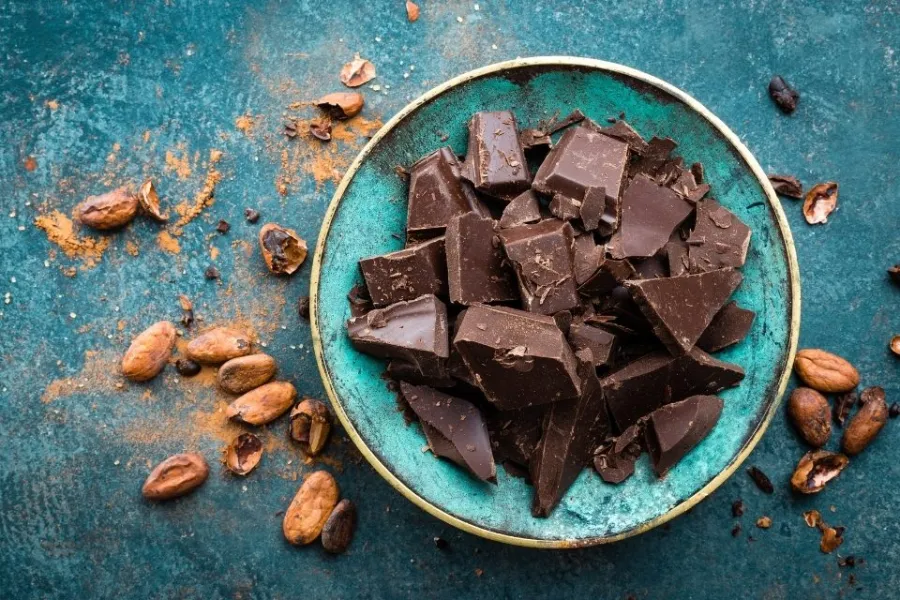
Chocolate is one of the world's favorite foods, but for most of its history it wasn't sweet and it wasn't eaten. It was a bitter, frothy drink, so prized in the ancient Americas that its beans were used as money. The scientific name of the cacao tree, Theobroma cacao, chosen by the Swedish botanist Carl Linnaeus in 1753, means "food of the gods."
Where chocolate comes from
Chocolate is made from the seeds of the cacao tree, an evergreen that grows to about 20 feet tall in hot, humid regions near the equator. Its large pods grow straight from the trunk and branches. Inside each pod, the seeds, or cacao beans, are surrounded by a sweet, white pulp. The beans are fermented, dried, roasted and ground into a thick paste called chocolate liquor (it contains no alcohol). Pressing the liquor separates it into cocoa butter and cocoa solids, which are ground into cocoa powder.
"Cacao" usually refers to the tree and its beans, and "cocoa" to the processed powder, though the two words are often used interchangeably.
Ancient origins
For a long time, chocolate was credited to the Aztecs, or to the Maya before them. In fact, it is much older. Cacao originated in the upper Amazon, and in 2018 researchers found traces of cacao on pottery from the Mayo-Chinchipe culture in what is now southern Ecuador, dating to about 5,300 years ago, the earliest known use of cacao by people.
Cacao was later domesticated in Mesoamerica, where it became central to culture and ritual. Residues on pottery show that people in what is now southern Mexico were drinking cacao around 3,900 years ago, and the Olmec, Maya and later the Aztecs all prized it. The Maya drank cacao at feasts and ceremonies and depicted it in their art; the Aztecs, who couldn't grow cacao in the cool highlands around their capital, received the beans as tribute and used them as currency.
Cacao was mostly drunk, not eaten. It was ground with water and often mixed with maize, chili, vanilla or flowers, then poured from a height to raise a prized layer of foam. It was associated with the elite, with warriors and with religious ceremonies.
The origin of the word "chocolate" is debated. It is often traced to an Aztec (Nahuatl) word meaning "bitter water," but that word doesn't appear in early sources, and some scholars think the term was coined in colonial Mexico, possibly blending Maya and Nahuatl words. "Cacao" itself comes from the Maya word kakaw.
Chocolate comes to Europe
Spanish conquistadors met cacao in the early 16th century. The soldier Bernal Díaz del Castillo, who was with Hernán Cortés, described the Aztec ruler Moctezuma being served frothy cacao drinks in golden cups. By the late 16th century, cacao was being shipped to Spain, where it was sweetened with sugar and flavored with cinnamon and vanilla and drunk hot.
Over the next century, drinking chocolate spread from the Spanish court to the rest of Europe, and chocolate houses opened in London and other cities alongside coffeehouses. Physicians of the time debated its medicinal virtues, recommending it for everything from stomach complaints to fatigue. In 1785, Thomas Jefferson wrote to John Adams that "the superiority of chocolate, both for health and nourishment, will soon give it the same preference over tea and coffee in America which it has in Spain."
From drink to bar
Chocolate remained mainly a drink until the 19th century, when a series of inventions transformed it:
- In 1828, the Dutch chemist Coenraad van Houten patented a press that removed much of the cocoa butter, making cocoa powder, and treated it with alkaline salts to make it mix more easily with water. "Dutch-processed" cocoa is named after him.
- In 1847, the British company J. S. Fry & Sons made one of the first solid eating chocolate bars by mixing cocoa powder, sugar and melted cocoa butter.
- In 1875, the Swiss chocolatier Daniel Peter created milk chocolate, using condensed milk developed by his neighbor Henri Nestlé.
- In 1879, Rodolphe Lindt invented conching, a long process of mixing and grinding that gives chocolate its smooth texture.
In the United States, Milton Hershey began making milk chocolate bars in 1900, and mass production made chocolate affordable for everyone. Early Hershey ads even promoted it as "more sustaining than meat," a claim no one would make today.
Types of chocolate
- Dark chocolate contains a high proportion of cocoa solids and cocoa butter and little or no milk.
- Milk chocolate, the most popular kind, contains cocoa solids, cocoa butter, milk and sugar.
- White chocolate contains cocoa butter, milk and sugar, but no cocoa solids.
Good chocolate is tempered, carefully heated and cooled so that the cocoa butter sets into stable crystals, which gives it its glossy finish and clean snap.
Why we love it
Chocolate contains theobromine and a little caffeine, mild stimulants that give a gentle lift, and tiny amounts of other compounds that have attracted plenty of headlines, though at levels too small to have much effect. The simplest explanation for chocolate's appeal is the best one: it melts at body temperature and tastes wonderful. Read more about whether chocolate is healthy and how chocolate can lift your mood.
Today chocolate turns up in everything from ice cream and cakes to Mexican mole sauces, chili and cocktails. It is a classic gift, part of celebrations from Easter to Valentine's Day, and a fine partner for a glass of wine. Find out more in our history of chocolate.
Sources
- The use and domestication of Theobroma cacao during the mid-Holocene in the upper Amazon (Zarrillo et al., Nature Ecology and Evolution, 2018)
Last reviewed November 2026.