
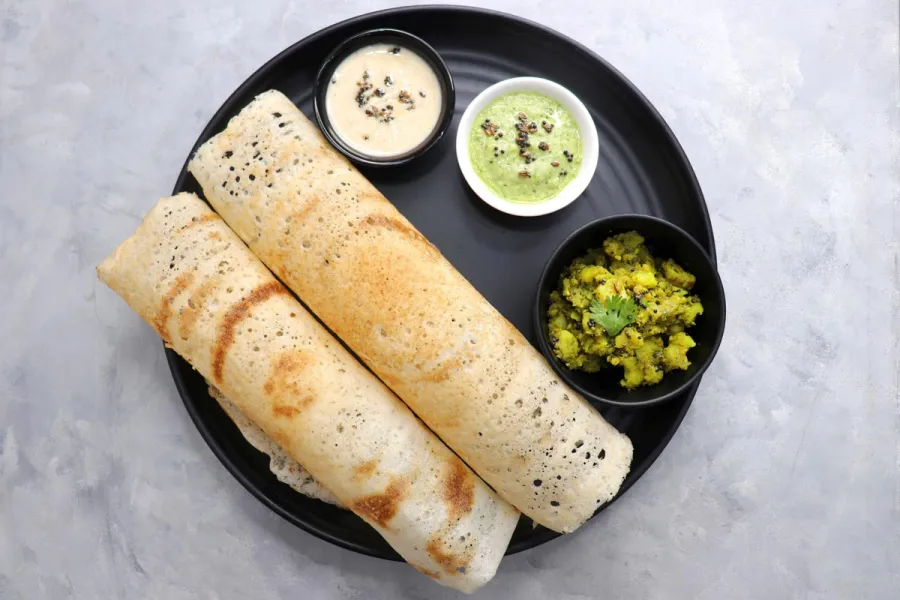
Dosa, from southern India, is a good example of the diversity of Indian cooking. It is a thin, crisp pancake made from a fermented batter of rice and lentils. All dosas begin that way, but each variety adds its own twist to this delightful dish.
Here is the recipe for plain dosa, the simplest, and a few examples of dosa variations.
Ingredients
Instructions
Rinse the rice and the urad dal separately until the water runs clear. Soak the rice in one bowl and the urad dal with the fenugreek seeds in another, each covered with plenty of water, for 4 to 6 hours.
Drain the urad dal and fenugreek, then grind them in a blender with a little fresh water to a smooth, fluffy paste. Drain the rice and grind it with a little water until smooth, with a slightly gritty texture.
Mix both batters with the salt in a large bowl. The batter should be thick but pourable. Cover and leave in a warm place for 8 to 12 hours, until it rises, looks bubbly and smells pleasantly sour.
Stir the batter, adding a little water if needed to make it the consistency of pancake batter.
Heat a cast-iron griddle or tava, or a nonstick skillet, over medium-high heat and rub it lightly with oil. Pour a ladleful of batter in the center and quickly spread it in a spiral with the back of the ladle into a thin circle.
Drizzle a little oil around the edges and cook for 2 to 3 minutes, until the bottom is golden and crisp and the edges lift. Most dosas are cooked on one side only; flip it briefly if you like.
Fold or roll the dosa and serve hot, with coconut chutney and sambar, or filled with potato masala. Repeat with the rest of the batter.
Rava dosa
Rava dosa is a quick variation that needs no soaking or fermenting. Mix 1 cup fine semolina (rava), 1/2 cup rice flour and 1/4 cup all-purpose flour with 1/2 cup buttermilk, about 2 cups water, salt, a little chopped fresh cilantro and green chili, and a pinch of cumin seeds. Let it rest for 20 minutes. The batter should be very thin. Pour it onto the hot griddle from a height, so it forms a lacy pancake, drizzle with oil and cook until crisp.
Paneer dosa
This variation uses paneer, the fresh Indian cheese, for richness. Make plain dosas and, as each one cooks, sprinkle it with crumbled or grated paneer, chopped onion, cilantro and, for a zesty touch, 1 or 2 finely chopped green chilies, then fold it over.
Masala dosa
For the best-known dosa of all, fill plain dosas with a spiced potato masala, fold them over and serve with chutney and sambar.
Jaggery dosa
For a quick sweet dosa, skip the rice batter. Dissolve 3/4 cup grated or powdered jaggery in 1 cup warm water and strain it. Whisk in 1 cup whole wheat flour, 1/4 cup rice flour, a pinch of salt and a pinch of ground cardamom, adding more water to make a pourable batter. Cook on a lightly greased griddle over medium heat, as jaggery burns easily, flipping once.
Food in Asia
Notes
India is a vast and ancient land, with more than two dozen states and over a billion people of many cultures, languages and traditions, so you might expect a highly varied cuisine. You see it even in everyday foods like dosa.
In cold weather, the batter takes longer to ferment; an oven with only the light on is a good warm spot. Leftover batter keeps in the refrigerator for a few days.
Jaggery dosas, a sweet variation, are delicious for breakfast.
Urad dal: split black gram, a small lentil-like bean popular in India. The white variety has the black skins removed.
Jaggery: unrefined cane or palm sugar, sold in blocks or as a powder in Indian grocery stores.