
Marsala wine
Ask most cooks about Marsala and they will mention Chicken Marsala, zabaione, or the small bottle in the back of the cupboard used for occasional sauces. That is an accurate picture of how most Marsala is used — and there is nothing wrong with it. But it is only half the story.
Marsala is a fortified wine from western Sicily with a DOC designation, a history that stretches back to the late 18th century, and a quality tier — Vergine — that produces serious, long-aged drinking wines comparable to a fine Amontillado Sherry. The fact that it is also one of the most useful wines in the kitchen is not a reason to dismiss it as a cooking ingredient and nothing more. This page covers both.
The city and the wine
Marsala is a port city on the westernmost tip of Sicily, facing Tunisia across the Strait of Sicily. Its name derives from the Arabic Marsa Allah — ‘port of God’ — a legacy of the Arab occupation of Sicily between the 9th and 11th centuries. The surrounding landscape is flat and sun-baked, with vineyards stretching across limestone and clay soils that suit the white grape varieties on which most Marsala is based.
The DOC zone covers the entire province of Trapani, with the best vineyards concentrated around the city itself and the neighbouring areas of Mazara del Vallo and Castelvetrano. The primary grape varieties are Grillo, Catarratto, and Inzolia (also known as Ansonica) for the golden and amber styles, and Nero d’Avola, Pignatello, and Nerello Mascalese for the rarer ruby (Rubino) style.
A British discovery, a Sicilian wine
Marsala’s origin story belongs to a British merchant named John Woodhouse, who was forced to shelter from a storm in the port of Marsala in 1796. Finding the local wine — already partially fortified with grape spirit by local practice — both delicious and stable enough to survive the sea voyage to England, he began shipping it home. To ensure it survived the journey, he added further grape spirit, a practice already established with Port and Madeira.
The wine found favour in Britain, and Woodhouse established the first commercial Marsala company. In 1798, Admiral Horatio Nelson provisioned his fleet with Marsala before the Battle of the Nile, which gave the wine a celebrity endorsement that money could not have bought. In 1833, the Sicilian entrepreneur Vincenzo Florio — whose family name still appears on one of Marsala’s most important producers — entered the market and gave the wine a firmly Italian identity. For much of the 19th century, Marsala was one of the most fashionable wines in Europe.
The 20th century was less kind. As Marsala was increasingly produced for cooking rather than drinking, quality declined, and the wine’s reputation declined with it. The turning point came in the 1970s and 1980s, when the winemaker Marco de Bartoli began producing Marsala Vergine of exceptional quality, arguing — correctly — that the wine had more to offer than supermarket cooking bottles. His work sparked a quality revival that continues today.
How Marsala is made
The base wine is fermented from white or red grapes and then fortified with grape spirit. What distinguishes Marsala from other fortified wines is the use of two additional ingredients that allow producers to adjust colour and sweetness:
- Mosto cotto is grape must that has been cooked down to a thick, dark syrup. Adding it to the base wine deepens the colour and increases sweetness. It is used only in the Ambra style, which requires it for its characteristic dark amber colour.
- Mistella (or sifone) is fresh grape juice whose fermentation has been arrested with grape spirit, preserving its natural sugar. It is used to adjust sweetness in Oro and other styles.
Marsala Vergine — the premium category — uses neither mosto cotto nor mistella. It is a pure fortified wine, aged in a solera-type system of progressively older barrels, developing complexity entirely through time and oak. This is why Vergine must always be dry: there is no added sweetness, only the richness that comes from long aging.
The classification system
Marsala’s DOC regulations classify the wine by colour, sweetness, and length of aging. The colour categories are Oro (golden), Ambra (amber, made with mosto cotto), and Rubino (ruby, from red grapes). Within each colour, the wine can be Secco (dry, under 40g/L sugar), Semisecco (semi-sweet), or Dolce (sweet, over 100g/L). The aging categories determine quality level:
| Category | Min. aging | Min. alcohol | Character |
| Fine | 1 year | 17% | Basic style; mainly used for cooking |
| Superiore | 2 years | 18% | More depth; good for cooking and drinking |
| Superiore Riserva | 4 years | 18% | Richer; worth drinking on its own |
| Vergine / Soleras | 5 years | 18% | Dry only; serious drinking wine, nutty and complex |
| Vergine Stravecchio | 10 years | 18% | Premium; exceptional depth and finesse |
For cooking, Fine and Superiore are perfectly adequate — the complexity of a Vergine is wasted in a pan sauce. For drinking, Superiore Riserva and Vergine are where the interest begins. A 10-year Vergine Stravecchio from a good producer is a revelation: amber-coloured, nutty, dried-fruit rich, with a long, warming finish and the sharp acidity that characterises all good fortified wines.
Marsala as a drinking wine
The case for drinking Marsala rather than merely cooking with it is straightforward: at the Vergine level, it is one of the most complex and under-appreciated fortified wines in the world, and it is significantly less expensive than comparable-quality Sherry or aged Tawny Port.
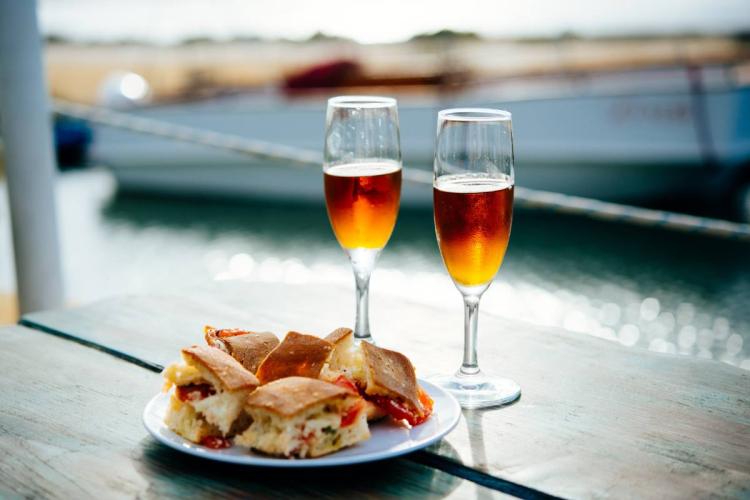
A dry Marsala Vergine served lightly chilled in a small glass is an excellent aperitif, particularly alongside Sicilian antipasti: caponata, olives and capers, bottarga, or a wedge of aged Pecorino. The sweetness is absent; what remains is a nutty, amber-coloured wine with dried-fruit aromas and the faintly saline edge that good Sicilian wines often carry.
Superiore Dolce — sweet amber Marsala — works well at the end of a meal alongside almonds, dried figs, or the almond pastries (pasta di mandorla) that are one of Sicily’s great contributions to the dessert table. The wine’s richness and honeyed sweetness are a natural match for Sicilian confectionery, which was itself shaped by Arab culinary traditions during the island’s medieval occupation.
For a broader guide to pairing wine with cheese and desserts, see our cheese and wine pairing guide.
Food pairing
Marsala’s range of styles means it covers the full span of the meal:
- Dry Vergine works as an aperitif with Sicilian antipasti, cured meats, hard aged cheeses (Pecorino Siciliano, Ragusano), olives, and caperberries. Serve lightly chilled.
- Superiore Secco accompanies chicken liver pâté, grilled or roasted meats, and mushroom dishes.
- Superiore Dolce and Ambra Dolce pair with zabaione, tiramisù, almond pastries, dried fruit and nut confections, and rich fruit-based desserts.
- Rubino (ruby, from red grapes) is the rarest style. When dry, it works with red meat and aged cheese; when sweet, with chocolate and dark fruit desserts.
Marsala in the kitchen
The kitchen is where most people encounter Marsala, and for good reason: it is one of the most versatile fortified wines in cooking. Its combination of sweetness, oak character, and grape spirit gives pan sauces a depth and richness that no table wine can match. The rule, as with all cooking wines, is to use something you would be happy to drink — a Superiore Secco or a decent Fine, not a product marketed primarily as a cooking condiment.
| Dish | Notes |
| Chicken Marsala | Thin-pounded chicken breast, pan sauce with dry Marsala and mushrooms. The Italian-American classic. |
| Veal Marsala (scaloppine al Marsala) | The Italian original; veal escalopes in a reduction of Marsala and butter. |
| Zabaione (zabaglione) | Egg yolks, sugar, and sweet Marsala beaten over a bain-marie into a warm, foamy custard. A dessert in itself. |
| Tiramisù | Sweet Marsala or dry Marsala used in some recipes to soak the ladyfinger biscuits. |
| Pan sauces for pork and duck | A splash of dry Marsala deglazes the pan; reduces with stock and butter into a rich sauce. |
| Stuffed mushrooms | Marsala added to the stuffing or used to baste the mushrooms during baking. |
| Consommé and meat broth | A small measure of dry Marsala stirred into the finished consommé before serving, as a finishing note. |
| Almond and fig cake | Sweet Marsala in Sicilian-style baking with almonds, dried figs, and spice. |
A practical note on substitutions: if a recipe calls for Marsala and you have none, dry Sherry (Amontillado or Oloroso) is the closest substitute in a savoury context. For sweet applications like zabaione, a sweet Sherry or Madeira works well. The flavour profile will not be identical, but the structural role — fortified wine adding richness and acidity to a sauce or custard — will be preserved.
Serving and storing
Marsala for drinking should be served at a temperature that reflects its style:
- Vergine (dry): lightly chilled — 54–57°F (12–14°C), similar to Amontillado Sherry
- Superiore Secco: lightly chilled or room temperature
- Superiore Dolce and Ambra Dolce: room temperature or slightly below — around 59–64°F (15–18°C)
Once opened, Marsala keeps considerably better than table wine thanks to its fortification. A dry Vergine will hold well in the refrigerator for four to six weeks. Sweeter styles are slightly more resilient and will keep for six to eight weeks. A cooking-grade Fine Marsala, once opened, is best used within a few months — keep it in a cool, dark place.
Unlike Vintage Port, Marsala does not develop significant sediment and does not need decanting. Older Vergine wines may benefit from being opened a little ahead of serving to allow the aromas to open up, but this is optional.
Fortified and aromatized wines — Sherry, Port, Madeira, vermouth, and the full family
A toast to Sherry — Amontillado and Oloroso are the closest equivalents to Marsala Vergine
Port wine — Another fortified wine with a strong kitchen presence
Madeira wine — Another fortified wine used in pan sauces and desserts
Vermouth — The other aromatized wine with a kitchen role
Pairing wine and cheese — Dry Vergine with aged Pecorino is a classic Sicilian pairing
Wine cocktails — Wine cocktails