
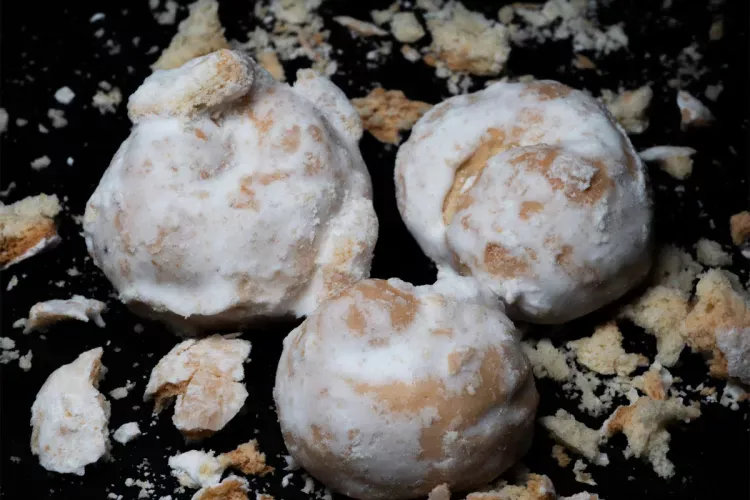
Anginetti are soft lemon cookies tied into loose knots and dipped in a white glaze, made across southern Italy for Easter and Christmas and carried to the United States by Neapolitan and Calabrian families. The knot is the point: it stands for two people joined together, which is why they appear at weddings and why they are sometimes sold as Italian wedding cookies.
Ingredients
Instructions
Put the flour, sugar, baking powder, salt and 2 teaspoons of the lemon zest into a food processor and pulse a few times to combine. Add the cold butter and pulse until it has broken down into pieces no larger than a pea.
Add the beaten egg and pulse briefly, then pour in the milk and pulse again just until the dough gathers into a rough mass. It will be soft and slightly sticky. Without a food processor, rub the butter into the dry ingredients with your fingertips, then work in the egg and milk with a fork.
Wrap the dough and refrigerate it for at least 4 hours, or overnight. This is not optional — warm dough cannot be rolled into ropes and will slump in the oven instead of holding its knot.
Heat the oven to 350°F and line a baking sheet with parchment.
Divide the chilled dough into 20 pieces of about 1 ounce each. Roll each one on a lightly floured surface into a rope about 6 inches long and roughly the thickness of a little finger.
Tie each rope into a single loose knot, leaving the two ends showing. Work quickly and return the dough to the refrigerator if it softens. Set the knots on the baking sheet about an inch apart; they spread very little.
Bake for about 20 minutes, until the cookies are set and barely colored. They should stay pale — a browned anginetto has gone too far and will be dry. Cool them completely on a wire rack before glazing.
Whisk the confectioner's sugar with the remaining teaspoon of lemon zest and the lemon juice, then add the boiling water a little at a time until the glaze is smooth and thick enough to coat the back of a spoon without running off it.
Dip the top of each cooled cookie into the glaze, or brush it over, and set them back on the rack. Leave them at least 2 hours for the glaze to set hard before stacking or storing them.
Nutrition115 estimated calories per serving
Notes
Before starting, zest the lemons and keep the zest covered until needed, and take the butter straight from the refrigerator rather than letting it soften. This is a dough built on cold butter cut into flour, not on creamed butter, and soft butter will give a greasier, flatter cookie.
The knot is what gives the cookie its name and its meaning, so tie it rather than coiling or rolling it into a ball. A single loose overhand knot with the ends left showing is correct. Pulled tight, the middle stays underbaked and the shape closes up as it rises.
If the glaze is going to carry sprinkles, scatter them on immediately after dipping, while the surface is still wet. Once it begins to set nothing will stick.
These keep well — four or five days in an airtight tin at room temperature, and they improve on the second day as the glaze firms and the crumb softens. They freeze well unglazed.
Don't confuse these with the other Italian wedding cookie, the round ball of ground nuts and butter rolled in confectioner's sugar. Both names attach to both cookies in American bakeries, but they are entirely different things.
Variations
With sambuca or limoncello. The traditional southern Italian version replaces the milk with 1/4 cup of sambuca or limoncello, adding the remaining 2 tablespoons of milk as usual, and puts a tablespoon of the same liqueur into the glaze. Neither the dough nor the glaze cooks the alcohol away entirely, so this version is not suitable for children or for anyone avoiding alcohol.
With anise. For the aniseed flavor without the liqueur, add 1/2 teaspoon of anise extract to the dough along with the egg and leave out 1 teaspoon of the lemon zest.
With orange. Swap the lemon zest for orange and use orange juice in the glaze. Common around Christmas.
Dipped whole. Instead of glazing only the tops, lower each cookie into the glaze and turn it so the whole knot is coated. Slower, messier, and the way most bakeries do it.
Source
Anginetti are a southern Italian cookie with a disputed address. One account puts their origin in Angri, in Campania near Pompeii, which would explain the name; another places them in Calabria. They are generally dated to the eighteenth century, and across the south they belong to Easter above all, appearing on Palm Sunday tables and again at Christmas.
They are also called uncinetti, meaning crochet hooks, because a baked knot looks like a knotted stitch of crochet work. Older recipes were made with lard rather than butter, which is how most southern Italian baking was done before the war.
In the United States the cookie became fixed to weddings. The knot was read as two lives tied together, and anginetti joined the tray of cookies that circulates at Italian-American receptions, alongside pizzelle and biscotti. The name "Italian wedding cookies" followed, which is where the confusion with the powdered-sugar nut balls began.